







Spotlights
AI Trainer, Data Trainer, AI Data Trainer, Model Trainer, Human Feedback Specialist, AI Quality Rater, Data Annotator, AI Response Evaluator, Prompt and Response Rater, AI Behavior Specialist, Domain Expert Trainer, RLHF Specialist, AI Content Evaluator, Data Labeling Specialist
When an AI chatbot gives a genuinely helpful answer instead of a confusing or wrong one, when it refuses to help with something dangerous, or when it explains a tricky math problem the way a good tutor would, someone taught it how to do that. This is one of the newest jobs in the world, so new that it does not even have one settled name yet. Companies call it an AI Trainer, a Data Trainer, an AI Quality Rater, or a dozen other titles, but underneath all those names is the same essential work: shaping what "good" looks like to a machine that is still learning.
AI Trainers and Data Trainers teach AI models by labeling and annotating data, writing high-quality example answers, comparing multiple AI responses and rating which one is better, and giving structured feedback that helps a model improve at a specific task, whether that is writing code, explaining science, drafting legal language, or having a safe and helpful conversation. This work often draws on real subject-matter expertise: a former teacher might train a model to explain math clearly, a nurse might evaluate whether medical answers are safe and accurate, and a writer might judge whether a response actually sounds natural. Trainers work alongside machine learning engineers and researchers, translating messy human judgment into the structured examples and ratings that actually change how a model behaves.
Using annotation platforms, rating tools, style guides, and detailed task instructions, AI Trainers turn subjective questions like "is this a good answer?" into consistent, well-documented data that shapes an AI system from the inside out. This role is different from a Data Engineer, who builds the pipelines that move and store data, and different from a Machine Learning Engineer, who builds and deploys the model itself. AI Trainers bring the human judgment and domain expertise that decides what the model should actually learn, and as AI systems get woven into more of daily life, that human judgment is becoming one of the most valuable and fastest-growing skills in the industry.
- Getting to directly shape how millions of people experience AI, often before anyone else has
- Using deep expertise in your own field, whether that's writing, science, law, or teaching, in a completely new way
- Working at the ground floor of a brand-new profession that is still being defined
- Seeing your judgment calls turn into real improvements in how an AI model behaves
Working Schedule
Most AI Trainers work full-time, though a substantial number work part-time, freelance, or on flexible contracts through specialized platforms and staffing agencies that connect trainers with AI companies. The work is almost entirely computer-based and often fully remote, since it mainly involves reviewing text, rating responses, and writing examples through an online platform. Deadlines and project-based work are common, since companies often need large batches of training data completed within specific windows to support a model update or new feature launch. Some trainers work as direct employees of AI companies, but many work as contractors or through third-party vendors that specialize in AI data work.
Typical Duties
- Writing high-quality example responses that demonstrate what a good answer looks like
- Comparing two or more AI-generated responses and rating which one is better and why
- Labeling and annotating data so it is usable for training or evaluating AI models
- Following detailed rubrics and guidelines to judge accuracy, tone, safety, and helpfulness
- Flagging harmful, biased, or factually incorrect AI outputs for review
- Providing structured feedback that helps engineers understand why a response succeeded or failed
- Building evaluation datasets that test how well a model performs on specific tasks
- Fact-checking AI responses against reliable sources in your area of expertise
- Writing prompts designed to test a model's limits or uncover weaknesses
- Documenting edge cases and unusual model behavior for the research team
- Participating in calibration sessions to keep ratings consistent across a team of trainers
- Reviewing and refining training guidelines as new issues or patterns emerge
Additional Responsibilities
- Specializing in a domain, such as coding, medicine, law, or creative writing, to bring deeper expertise
- Training and onboarding new trainers on rating guidelines and best practices
- Identifying patterns of AI mistakes and suggesting new training priorities
- Collaborating with machine learning engineers to explain the reasoning behind ratings
- Participating in bias and safety reviews of sensitive AI outputs
- Testing new evaluation methods or rating systems before they roll out broadly
- Keeping detailed records of completed work for quality tracking
- Staying current on how AI models are evolving and what new skills they need
An AI Trainer's day often starts by logging into an annotation or evaluation platform and reviewing the day's task queue, which might include comparing pairs of AI responses to a tricky question, rating how well a model followed instructions, or writing a strong example answer from scratch. Each task usually comes with a detailed rubric, and trainers spend real time reading carefully before making a judgment call.
Midday work often involves deeper, more specialized tasks, especially for trainers with subject-matter expertise. A trainer with a science background might fact-check a batch of AI-generated explanations, while one with a legal background reviews whether a model's answers about contracts are accurate and appropriately cautious. Trainers frequently take notes on patterns they notice, like a model consistently struggling with a certain type of math problem or giving overly cautious answers to harmless questions.
Afternoons often include calibration meetings, where trainers compare notes with teammates to make sure everyone is applying the guidelines the same way, since consistency across thousands of ratings is what makes the training data useful. Trainers might also write up detailed feedback on especially interesting or problematic examples, flag them for the research team, and wrap up by completing any remaining tasks in the day's queue.
Soft Skills
- Strong, consistent judgment when evaluating quality and accuracy
- Attention to detail and careful reading
- Clear, structured written communication
- Objectivity and the ability to set aside personal opinion when following a rubric
- Patience with repetitive tasks that still require full focus
- Critical thinking and the ability to spot subtle errors or bias
- Comfort giving and receiving detailed feedback
- Ethical awareness, especially around safety, fairness, and harm
- Adaptability as guidelines and tasks change frequently
- Curiosity about how AI models think and where they go wrong
- Collaboration skills for calibration and team discussions
- Self-motivation, especially in remote or freelance arrangements
Technical Skills
- Deep knowledge in a specific subject area, such as coding, science, law, medicine, or writing
- Familiarity with annotation and evaluation platforms and tools
- Understanding of how large language models generate responses, at a conceptual level
- Basic fact-checking and research skills using reliable sources
- Ability to follow detailed, sometimes technical rating rubrics precisely
- Familiarity with concepts like reinforcement learning from human feedback (RLHF)
- Strong writing skills for producing clear example responses
- Basic data literacy for understanding how your ratings feed into a larger dataset
- Comfort with spreadsheets or simple data tools for tracking and organizing work
- Awareness of AI safety, bias, and fairness concepts
- General Response Rater: Compares and rates AI outputs for overall quality and helpfulness
- Subject-Matter Expert Trainer: Brings specialized knowledge in fields like medicine, law, or coding
- Safety and Red Team Specialist: Tests models by probing for harmful, biased, or unsafe outputs
- Coding Data Trainer: Reviews and writes examples of high-quality code and technical explanations
- Conversational AI Trainer: Focuses on natural, helpful, and appropriately toned dialogue
- Evaluation Dataset Builder: Designs structured tests to measure model performance on specific tasks
- Multilingual Data Trainer: Trains and evaluates model performance across different languages
- Fact-Checking Specialist: Verifies the accuracy of AI-generated information against reliable sources
- AI research labs and foundation model companies
- Big technology companies building AI products and features
- Specialized data annotation and AI training vendors
- Staffing and freelance platforms connecting trainers with AI projects
- Startups building AI tools for specific industries like healthcare or law
- Universities and research institutions studying AI behavior
- Government agencies exploring responsible AI use
- Consulting firms advising companies on AI quality and safety
- Media and publishing companies using AI trainers to guide content tools
- Educational technology companies building AI tutoring products
Because this role is so new, expectations and job titles can shift quickly, and trainers often have to adapt to changing guidelines, tools, and priorities with little advance notice. What counts as a "good" response can change as a company updates its priorities, which means trainers need to stay flexible rather than expecting a fixed, predictable routine.
Much of the work is done through contract or freelance platforms rather than traditional full-time employment, which can mean less job security, inconsistent workloads, and the need to manage your own schedule and income. The work itself can also be mentally demanding in a quieter way, since carefully evaluating hundreds of responses a day requires sustained focus and resistance to fatigue-driven shortcuts.
Trainers working on safety-related tasks may occasionally be exposed to difficult or sensitive content as part of testing how a model handles harmful requests, which requires emotional resilience and clear boundaries. Because the field is still forming, there is not yet a well-worn career ladder, so trainers who want to grow often have to build their own path by developing specialized expertise or moving toward adjacent roles like AI research or machine learning engineering.
- Explosive growth in demand for human feedback to train and fine-tune large language models
- Rising use of reinforcement learning from human feedback (RLHF) as a core training technique
- Increasing demand for subject-matter experts, not just general raters, as models tackle specialized fields
- Growth of dedicated AI training and evaluation platforms and marketplaces
- Expansion of red-teaming and safety evaluation as AI systems take on higher-stakes tasks
- Rising focus on reducing bias and improving fairness through diverse human feedback
- Growing overlap between AI training work and traditional research and quality assurance roles
- Increased use of AI trainers to build benchmarks that measure model progress over time
- More companies building in-house trainer teams rather than relying solely on outside vendors
- Ongoing debate and evolving standards around fair pay and working conditions for data trainers
Many AI Trainers grew up as careful readers and thoughtful critics, the kind of person who noticed when a movie's plot did not add up or when an essay's argument had a hole in it. They often enjoyed subjects like writing, debate, science, or math specifically because those fields rewarded precise thinking and clear explanations, and they liked being the person who could explain a tricky idea in a way that finally made sense to someone else.
Others were drawn to teaching, tutoring, or mentoring younger students, enjoying the process of breaking down a hard concept and figuring out exactly where someone's understanding went wrong. Many were also early and curious users of technology, fascinated by chatbots, video game AI, or online tools, and enjoyed poking at them to see where they succeeded and where they broke down.
Because this is such a new and still-forming role, there is no single required degree, and people enter from many different backgrounds. Many AI Trainers hold a bachelor's degree in a specific field like computer science, English, education, law, nursing, or a science, and it is often that subject-matter expertise, not a specific "AI training" credential, that makes someone valuable for the role. Some trainers come from teaching, editing, research, or technical backgrounds and transition into AI training through short online courses or on-the-job training provided directly by AI companies or vendors.
Students can take courses in relevant subjects such as:
- Writing and Composition
- Statistics and Data Literacy
- Computer Science Fundamentals
- Logic and Critical Thinking
- Ethics, including AI Ethics where available
- A specialized subject area such as biology, law, or coding, depending on your interests
- Linguistics or Communication Studies
- Introduction to Artificial Intelligence and Machine Learning
- Psychology, especially related to bias and decision-making
- Research Methods and Fact-Checking
Because the field is so new, hands-on experience often matters more than formal credentials. Building genuine depth in a subject area, practicing careful writing and critical thinking, and gaining any experience with AI tools, annotation platforms, or online evaluation work all help build a competitive profile. Many trainers continue learning informally as AI training practices and best guidelines evolve quickly year to year.
- Take challenging English, writing, and debate classes to sharpen your reasoning and clarity
- Build real depth in a subject you love, whether that's biology, coding, history, or art
- Take an introductory computer science or AI course to understand how these systems actually work
- Practice giving detailed, specific feedback on other people's writing or projects
- Experiment thoughtfully with AI chatbots and notice where their answers are strong or weak
- Join debate club, a writing team, or a research project that rewards precise thinking
- Look for a summer program or online course introducing AI, machine learning, or data ethics
- Try freelance or volunteer editing, tutoring, or fact-checking to practice evaluative skills
- Read about AI ethics and safety to understand why careful human feedback matters
- Explore internships or projects at companies working on AI products, even in a small role
- Practice explaining your reasoning clearly, since this job is all about showing your thinking
- Talk to anyone working in AI, data annotation, or related tech roles about their day-to-day work
- Strong programs in your subject area of choice, since deep expertise matters most in this field
- Courses or electives introducing AI, machine learning, or data ethics concepts
- Opportunities to practice detailed critical writing, editing, or feedback
- Access to research projects or internships involving real data or AI tools
- Faculty or mentors who can speak to how your subject connects to emerging tech careers
- Programs that build strong research and fact-checking skills
- Flexible or online options, since many people enter this field from unrelated career paths
- Opportunities to build a portfolio of writing samples or evaluative work
- Exposure to statistics and basic data literacy, even outside a technical major
- A learning environment that rewards precise, well-supported reasoning over quick answers
- Career services aware of emerging roles in AI training and data work
- Any coursework or clubs focused on logic, argumentation, or structured decision-making
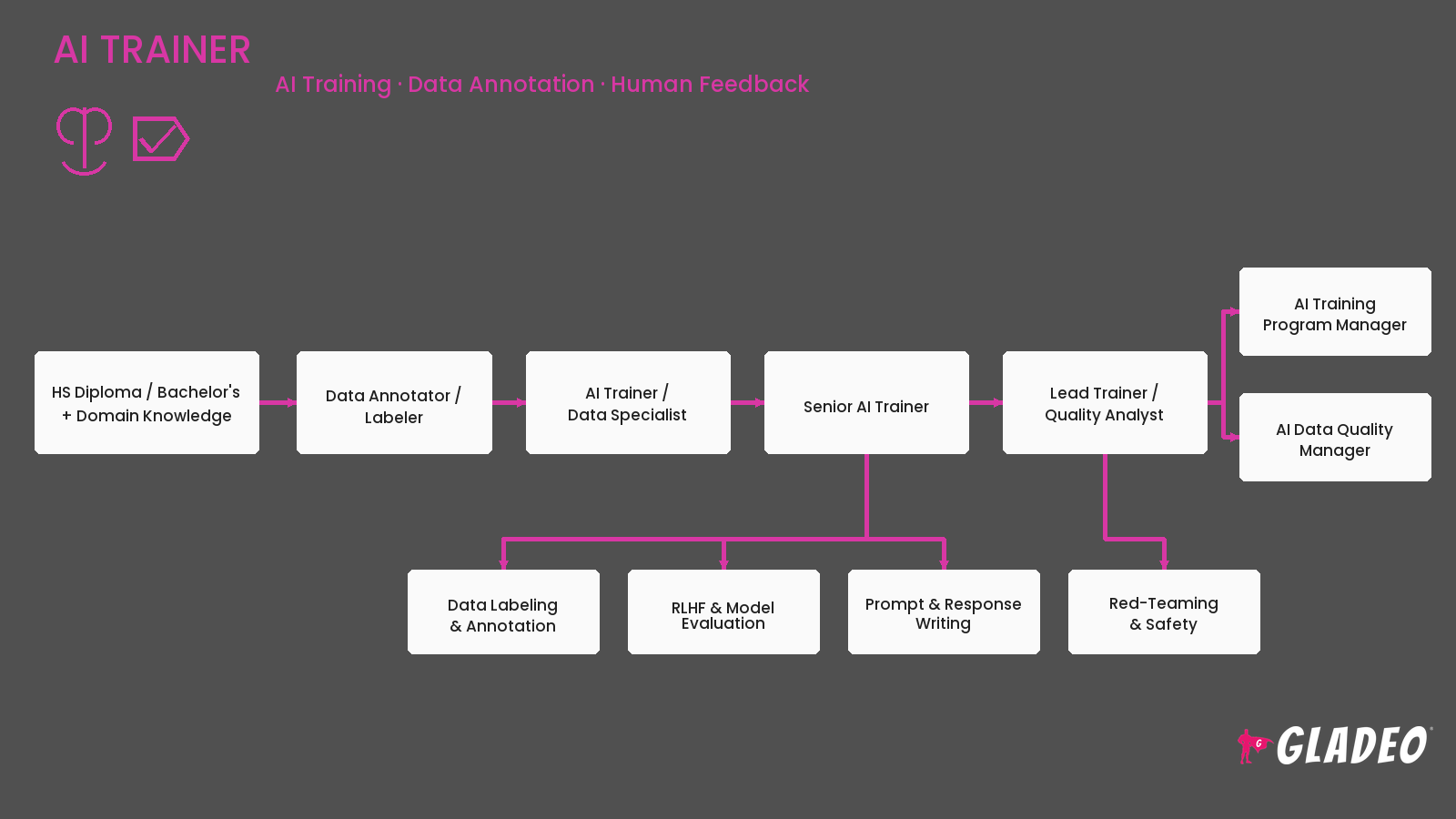
- Search specialized AI training and annotation platforms that connect workers with AI companies
- Apply directly to AI research labs and tech companies for roles titled AI Trainer, Rater, or Annotator
- Highlight deep expertise in a specific subject, since specialists are in especially high demand
- Build a small portfolio of writing samples, critiques, or evaluations that show careful reasoning
- Practice explaining your judgment out loud, since interviews often include sample rating exercises
- Search job boards like LinkedIn and Indeed using terms like "AI trainer," "data annotator," or "model evaluator"
- Consider starting through a staffing agency or vendor that supplies trainers to larger AI companies
- Emphasize past experience in teaching, editing, research, or quality assurance, which transfers well
- Be ready to demonstrate strong writing and communication skills during the application process
- Network with people already working in AI, data science, or tech through LinkedIn and online communities
- Stay flexible about contract or part-time arrangements, since many entry points start this way
- Show genuine curiosity about how AI models work and where they currently fall short
- Develop specialized expertise in a high-demand area like coding, law, medicine, or safety evaluation
- Build a reputation for consistent, high-quality, well-documented judgment
- Move into roles that shape training guidelines rather than only following them
- Learn more about machine learning and how training data actually changes model behavior
- Take on mentoring or team-lead roles training and calibrating newer trainers
- Explore transitions into adjacent careers like AI research, prompt engineering, or machine learning
- Build relationships with the engineers and researchers who rely on your feedback
- Stay engaged with how the field is evolving, since new specialties are emerging constantly
Websites:
- Partnership on AI - partnershiponai.org
- AI Alignment Forum - alignmentforum.org
- Stanford HAI (Human-Centered Artificial Intelligence) - hai.stanford.edu
- DAIR Institute (Distributed AI Research Institute) - dair-institute.org
- OpenAI Research Blog - openai.com/research
- Anthropic Research - anthropic.com/research
- Hugging Face - huggingface.co
- MIT Technology Review (AI section) - technologyreview.com/topic/artificial-intelligence
- The Gradient - thegradient.pub
- Association for Computational Linguistics (ACL) - aclanthology.org
- AI Now Institute - ainowinstitute.org
- Data & Society - datasociety.net
- Coursera (AI Ethics and Machine Learning courses) - coursera.org
- freeCodeCamp - freecodecamp.org
Books:
- The Alignment Problem by Brian Christian
- Weapons of Math Destruction by Cathy O'Neil
- Human Compatible by Stuart Russell
- Atlas of AI by Kate Crawford
- You Look Like a Thing and I Love You by Janelle Shane
If you find that being an AI Trainer isn't the right fit, your skills in critical thinking, writing, and evaluating information transfer to many related careers.
- Data Engineer
- Machine Learning Engineer
- Technical Writer
- Content Strategist
- Quality Assurance Analyst
- Research Analyst
- Instructional Designer
- Editor
- UX Researcher
- Data Analyst
Click here to download the infographic
Newsfeed

Featured Jobs
Online Courses and Tools