







Spotlights
Biomedical Electronics Technician, Biomedical Engineer, Biomedical Engineering Technician, Biomedical Equipment Technician (BMET), Biomedical Technician, Engineer, Process Engineer, Research Engineer, Research Scientist
Biomedical Engineers work in a broad field that currently has a relatively small number of workers. Collaborating with scientists and chemists, they help make cutting-edge medical IT, devices, and equipment used in modern hospitals and clinics around the world. They also work on life-saving artificial organs and replacements for other parts of the human body such as knee joints.
There are different areas of specialization, including Bioinstrumentation, Biomaterials, Biomechanics, Clinical engineering, Rehabilitation engineering, and Systems physiology. As you can see, there is plenty of opportunity for diversity in this sector. However, they all share a common purpose of creating technology to assist people.
As with any mechanical or electrical device, there will always be requirements for maintenance, diagnostics, repairs, and tech support. Biomedical Engineers help to ensure the items they create function properly and safely. There’s a considerable amount of research and design involved, as well as tons of technical writing and presentation preparation. Once created, products must be marketed and sold to buyers, so there are teams who focus on this aspect of the field, too.
- Having a direct impact on patients’ life spans and overall quality of life
- Continually contributing to the advancement of medical technologies
- Gaining experience with the business side of the healthcare profession
- Potentially inventing items for patenting
Working Schedule
- Biomedical Engineers work full time, with occasional overtime required in some cases. For instance, when there is a high demand or urgent need for the production of a certain product, schedules may require working extra hours to meet deadlines. Also, employees must ensure they’re always current with changes affecting their field. This can require significant reading and research outside of “office hours.”
Typical Duties
- Designing hardware and software for various medical uses
- Conducting detailed research related to biology and chemical processes
- Working with or managing teams and other engineers
- Assessing the designs of biomedical components to be used inside patients
- Conducting operational testing and analyzing findings
- Complex technical writing and diligent records keeping
- Performing sensitive calibrations using technical equipment
- Training peers or subordinates on processes
- Additional Responsibilities
- Assisting buyers and providing training on the proper use of products
- Developing alternative energy solutions
- Inventory management
Mornings often start with reviewing project progress, analyzing test data, and planning experiments. Biomedical Engineers meet with team members to discuss challenges and next steps. They might review feedback from clinical trials or hospital staff to refine device designs.
Midday involves hands-on work such as creating CAD models, running simulations, or assembling prototypes. Engineers frequently collaborate with scientists or medical professionals to ensure designs meet practical and safety requirements, adjusting plans as new information emerges.
Afternoons are spent documenting findings, preparing reports, or presenting updates to stakeholders. They might coordinate with manufacturing teams or regulatory experts to move devices closer to market. Project deadlines and problem-solving often require focused concentration and creative thinking to keep innovations on track.
Soft Skills
- Articulate speaking
- Strong technical writing skills
- Able to advise and instruct others through verbal and written guidance
- Analytical problem solving
- Methodical
- Objective
- Patience and persistence
- Focused on quality assurance
- Goal-orientation; ready to tackle challenges
- Planning and organizational skills
- Research and troubleshooting skills
- Team-orientation
- Empathy dealing with patients
Technical Skills
- Creative, especially in design areas
- Ability to read and comprehend complex technical texts
- Deep understanding of biology and applicable engineering and technology
- Knowledge of software applications, in particular those related do:
- Medical, analytical, and scientific
- Computer-aided design
- Development environment
- Object/component oriented development
- Strong math skills, including calculus and statistics
- Ability to create compelling presentations and reports
- Focus on practical, real-world solutions versus theory
- Companies making medical equipment, medical supplies, or auxiliary items
- Healthcare industries
- Pharmaceuticals
- Higher education institutes
- Research and development groups
- Military/governmental agencies and contractors
- Social welfare organizations
- Clinical Engineer: Focuses on managing medical equipment in healthcare facilities and training staff.
- Biomechanical Engineer: Applies mechanics to study human movement and develop related devices.
- Biomaterials Engineer: Develops materials compatible with the human body for implants and prosthetics.
- Rehabilitation Engineer: Designs assistive technologies to help patients regain function.
- Tissue Engineer: Works on growing tissues and organs for transplantation.
- Prosthetics Engineer: Creates artificial limbs and devices to restore mobility.
- Medical Imaging Engineer: Develops technologies for visualizing the inside of the body.
- Biomechatronics Engineer: Integrates biology with robotics to create advanced prosthetic devices.
Biomedical Engineers bear the weight of enormous responsibility. Unlike physicians who may see specific patients on occasion, Biomedical Engineers create devices implanted permanently inside patients! The effectiveness and proper functioning of such devices can impact the quality of life of those individuals. Meanwhile, malfunctions or other unexpected problems can have serious, even life-threatening consequences.
Workers in this field must go to great lengths to ensure their research is accurate, and that they’ve developed solutions that will work as designed. They have to anticipate issues and train buyers on use, maintenance, and what to do in case of trouble. An organization’s entire reputation is on the line when a product or service is released into the world, so when things go wrong, engineers get scrutinized. Thus they need to be patient, have a tough skin, and be ready to answer questions at any time.
Curiously, the Bureau of Labor Statistics only predicts a 4% job growth outlook for Biomedical Engineers over the coming decade. This is slightly below average. However, changes are certainly expected within the field itself, as technology continues to evolve at an increasing pace. As tech advances, opportunities open. For example, 3D printing is becoming an area of increased focus in the Biomed world. Meanwhile, smart technology continues to bind us to an ever-widening network of connected devices, so this is another area being explored.
A further consideration impacting the future outlook for Biomedical Engineers is the increasing life expectancy rate for citizens. As populations live longer, the need for products will continue to expand. However, advanced aging can affect the ability to perform certain surgeries to implant certain items. This may potentially drive research into new paths to seek non-surgical alternatives to existing products.
Biomedical Engineers were likely always curious about both biology and technology, and how the two can function together. They may have been fond of science fiction books and films featuring futuristic characters such as cyborgs and androids. Indeed the science fiction genre has long been at the forefront of predicting ways that humans will intersect with man-made devices such as computers or robotic equipment.
In their younger days, Biomedical Engineers may have also drawn inspiration from real-life pioneers in the field. They might even have had a family member who relied on a biomedical device for survival. In addition, there could also have been an interest in military and warfare topics. The military has long been a supporter of advanced technologies designed to enhance the performance of troops, as well as to empower survivors of serious wartime injuries. This is why many veterans consider civilian jobs in this critical field.
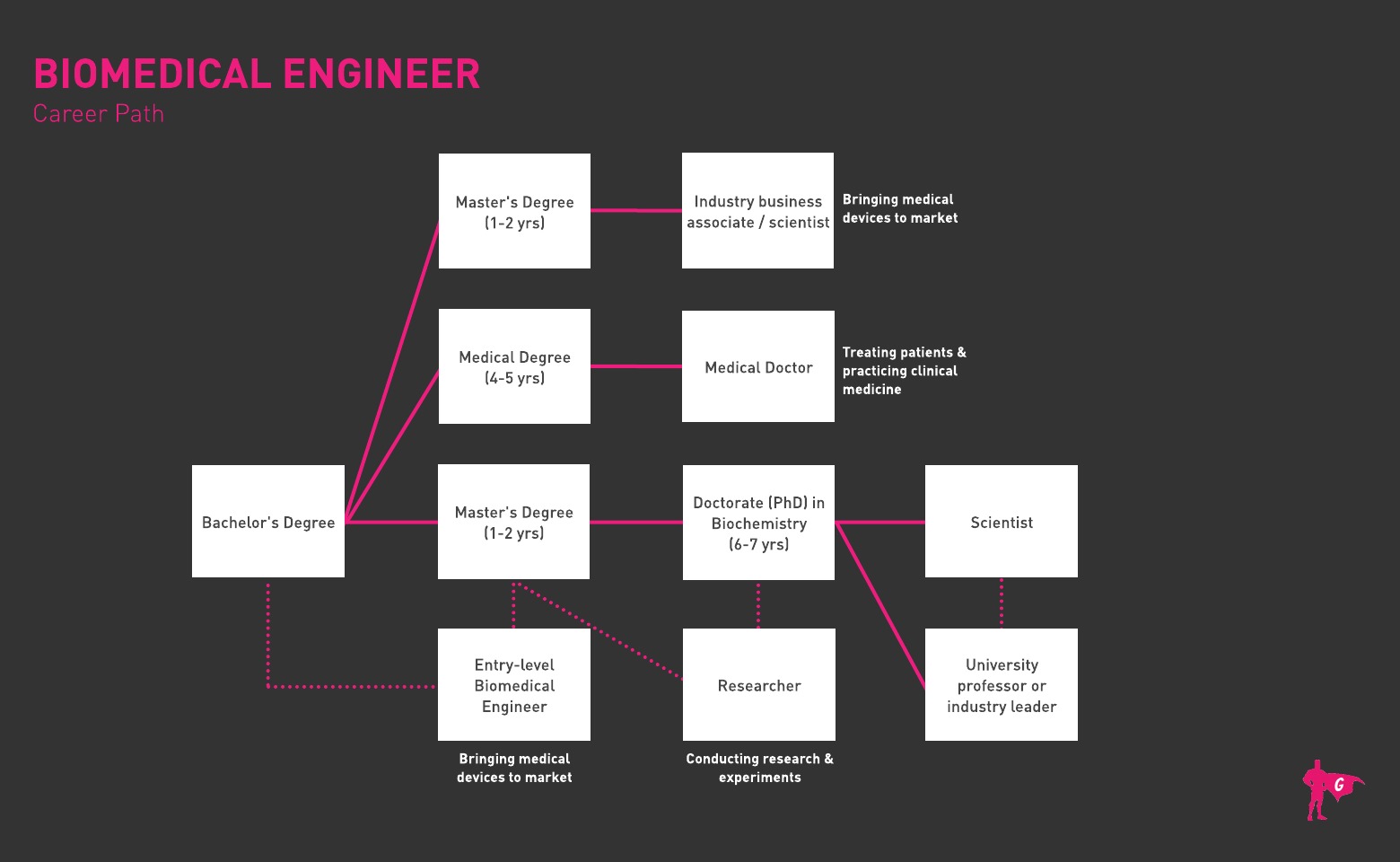
Becoming a Biomedical Engineer typically requires a bachelor’s degree in biomedical engineering or a related engineering field. Many also pursue advanced degrees to specialize or conduct research. Education blends engineering principles with biology, anatomy, and medicine to prepare students for designing medical technologies.
Students can take courses in relevant subjects such as:
- Biology and Human Anatomy
- Chemistry
- Physics for Engineers
- Mathematics (Calculus and Statistics)
- Introduction to Biomedical Engineering
- Biomechanics
- Biomaterials
- Medical Imaging
- Computer-Aided Design (CAD)
- Electrical Circuits and Systems
Hands-on experience through internships, lab work, and senior design projects is crucial. Building a strong portfolio of engineering projects and gaining familiarity with medical regulations will boost job prospects. Some roles require graduate degrees or certifications focused on medical device development or clinical engineering.
- Prepare for college by taking science classes, including biology, chemistry, and physics
- Don’t forget to build a strong math foundation in algebra, geometry, trigonometry, and calculus
- Experience with drafting software, mechanical drawing, and programming will come in handy
- Study current topics, but build a rock-solid understanding of core concepts
- Seek out internships/co-ops that offer practical experiences
- Join relevant groups dedicated to the field; several universities host engineering clubs and organizations
- Devote time every day to polishing your technical reading and writing skills
- Remember that there is a sales and marketing element to some areas in this field, as well as a strong customer service component
- Practice your public speaking and presentation technique
- Volunteer at clinics or locations where patients may rely on biomedical technologies
- Stay ahead of the curve by reading industry materials and joining national and international professional organizations, such as:
- American Institute for Medical and Biological Engineering
- American Society of Biomechanics
- American Society for Engineering Education, Biomedical Engineering Division
- American Society of Mechanical Engineers, Bioengineering Division
- Association for the Advancement of Medical Instrumentation
- Biomedical Engineering Society
- European Society for Biomaterials
- European Society of Biomechanics
- IEEE Engineering in Medicine and Biology Society
- Institute of Biological Engineering
- Institute of Physics and Engineering in Medicine
- International Federation for Medical and Biological Engineering
- International Society of Biomechanics
- International Society for Prosthetics and Orthotics
- International Union for Physical and Engineering Sciences in Medicine
- PLoS Medicine
- Society for Biomaterials
- Look for accredited biomedical engineering programs.
- Check for strong lab and research facilities.
- Seek programs with industry partnerships and internships.
- Evaluate faculty expertise and research areas.
- Consider schools offering interdisciplinary courses with medicine.
- Ensure program covers medical device regulations.
- Look for opportunities to work on real-world projects.
- Assess availability of graduate programs for specialization.
- Choose programs with good career placement support.
- Consider programs offering hands-on training and prototyping resources.
- Apply for internships in medical device companies or research labs.
- Create a portfolio showcasing engineering and biology projects.
- Develop proficiency in CAD and simulation software.
- Network with professionals through industry events.
- Prepare for technical interviews with problem-solving exercises.
- Gain experience with regulatory standards.
- Volunteer for assistant roles in clinical or engineering departments.
- Seek mentoring from experienced engineers.
- Stay updated on biomedical engineering trends.
- Practice clear communication of technical concepts.
- Build relationships with healthcare professionals.
- Consider certifications in medical device design or quality control.
- To get ahead or have increased responsibilities such as leading teams, you’ll likely need a graduate degree
- Your graduate area of study should be based on the specific job you want, so plan for the long-term. Some worker obtain an MBA, while others go to medical school
- Study the positions and duties of those you work for. Find a person who is doing what you’d like to do and ask them to mentor you
- Don’t be shy! Let your organization know you are focused on your current job, but interested in future career-broadening opportunities
- Excel at tasks you’re given; offer solutions when citing challenges and obstacles
- Pay your dues and put in the overtime when required
- Never cut corners but do look for ways to improve process efficiency and efficacy
- Join professional organizations (see our list above)
- Stay up on trends with an eye on pending breakthroughs and advanced technologies
- Be a professional trainer, relied on to teach others how to perform difficult tasks
- Comply with internal and external policies; maintain the utmost integrity on-and-off duty
Websites
- Accreditation Board for Engineering and Technology
- American Association for the Advancement of Science
- American Board for Certification in Orthotics, Prosthetics and Pedorthics
- American Chemical Society
- American Institute for Medical and Biological Engineering
- American Institute of Chemical Engineers
- American Society for Engineering Education
- American Society for Healthcare Engineering
- American Society for Microbiology
- American Society of Agricultural and Biological Engineers
- BioMed Central
Books
- Biomedical Device Technology: Principles and Design, by Anthony Y. K. Chan
- Biomedical Engineering and Human Body Systems, by Rebecca Sjonger
- Introduction to Biomedical Engineering Technology, by Laurence J. Street
- Intermediate Physics for Medicine and Biology, by Russell K. Hobbie, et. al.
- Biomedical Engineering: Bridging Medicine and Technology, by W. Mark Saltzman
- Lab Manual for Biomedical Engineering, by Gary Drzewiecki
- Non-Invasive Instrumentation and Measurement in Medical Diagnosis, by Robert B. Northrop
If biomedical engineering isn’t the perfect fit, many related careers still allow you to work with technology, healthcare, or research to make a difference.
- Mechanical Engineer
- Electrical Engineer
- Clinical Engineer
- Materials Scientist
- Biotechnologist
- Healthcare Technology Manager
- Research Scientist
- Quality Assurance Engineer
- Medical Laboratory Technician
- Rehabilitation Therapist
Newsfeed

Featured Jobs
Online Courses and Tools