






Spotlights
Financial Controller, Corporate Controller, Accounting Controller, Financial Planning Manager, Budget Manager, Cost Controller, Finance Manager, Business Financial Analyst, Management Accountant, Treasury Controller, Financial Operations Manager, Strategic Finance Analyst
Every decision a company makes hinges on understanding where its money comes from and where it goes. Business Controllers are the financial detectives and strategists who help companies steer their course confidently by ensuring financial stability, compliance, and growth.
Business Controllers work closely with finance teams, department heads, and company executives to analyze financial data, prepare budgets, forecast future financial performance, and ensure that all operations align with strategic goals. They dig into profit and loss statements, cash flows, and cost structures daily, helping leaders make informed decisions that protect and grow the business.
Using advanced financial software and analytical methods, Business Controllers monitor financial health, assess risks, and recommend cost-saving measures. Their role is vital because they translate complex numbers into clear strategies, enabling companies to plan for success and avoid pitfalls.
- Seeing the direct impact of your financial insights guiding a company’s success and growth.
- Helping teams and leaders make smart, data-driven decisions that shape business futures.
- Working at the crossroads of finance, strategy, and operations, constantly learning about different facets of a business.
- Being a trusted advisor who can influence important financial and operational choices that affect many people.
Working Schedule
Business Controllers usually work full-time in office environments or remotely, often during regular business hours. However, depending on company size and deadlines—like quarterly reports or annual budgets—they may work extra hours, including evenings or weekends. Many work as part of in-house finance teams but can also be consultants or freelancers supporting multiple clients.
Typical Duties
- Develop and oversee company budgets and financial forecasts.
- Analyze monthly, quarterly, and annual financial reports to identify trends and variances.
- Prepare management reports that summarize financial performance and operational efficiency.
- Collaborate with department managers to set financial targets and monitor spending.
- Assess financial risks and develop strategies to mitigate them.
- Ensure compliance with accounting standards and financial regulations.
- Monitor cash flow and working capital to maintain financial health.
- Advise senior management on financial implications of strategic decisions.
- Lead internal audits and coordinate with external auditors.
- Implement financial controls and improve existing processes for accuracy and efficiency.
- Support business planning with scenario analyses and investment evaluations.
- Track project costs and profitability to guide resource allocation.
Additional Responsibilities
- Train and mentor junior finance staff and analysts.
- Participate in cross-functional teams for business improvement initiatives.
- Stay updated on changes in financial laws, regulations, and best practices.
- Develop and maintain financial policies and procedures.
- Coordinate with IT teams to implement financial software solutions.
- Support mergers, acquisitions, or restructuring projects with financial analysis.
- Prepare presentations for board meetings and investor communications.
- Conduct market and competitor financial benchmarking.
Mornings often start with reviewing key financial dashboards and reports from the previous day, checking for any urgent issues or anomalies that require immediate attention. Business Controllers also prepare for meetings with department heads to discuss budget status and financial targets.
Midday is packed with collaboration—meeting with finance teams, operations managers, and executives to analyze performance, troubleshoot financial challenges, and plan for upcoming projects. They might also be deep in data analysis or crafting detailed reports during this time.
Afternoons and evenings often involve finalizing reports, updating forecasts based on new data, and preparing presentations for leadership reviews. Approaching deadlines can increase pressure, but Business Controllers balance this with mentoring colleagues and continuous learning to stay sharp.
Soft Skills
- Strong analytical thinking and problem-solving
- Excellent communication and presentation skills
- Attention to detail and accuracy
- Ability to work under pressure and meet deadlines
- Collaborative mindset and teamwork
- Adaptability and openness to feedback
- Organizational skills and time management
- Critical thinking to challenge assumptions
- Discretion and integrity with sensitive information
- Leadership and mentoring abilities
- Strategic thinking and business acumen
- Curiosity and continuous learning mindset
Technical Skills
- Advanced proficiency with Excel and financial modeling
- Experience with ERP systems like SAP, Oracle, or Microsoft Dynamics
- Knowledge of accounting principles and standards (GAAP, IFRS)
- Familiarity with budgeting and forecasting software
- Competency with data visualization tools (Power BI, Tableau)
- Understanding of financial reporting and compliance
- Ability to analyze large datasets and identify trends
- Use of audit and internal control procedures
- Proficiency in financial planning software
- Basic knowledge of SQL or database querying
- Corporate Business Controller: Focuses on internal financial management within a single company, overseeing budgets and forecasts.
- Project Business Controller: Manages financial aspects of specific projects, ensuring costs stay within budgets.
- Group Business Controller: Oversees financial control and reporting for multiple companies within a corporate group.
- Operational Business Controller: Works closely with operations teams to optimize costs and efficiency.
- Financial Planning Controller: Specializes in long-term financial planning and strategy development.
- Cost Controller: Concentrates on controlling production or operational expenses to improve profitability.
- Treasury Controller: Manages cash flow, financing, and liquidity aspects.
- Consultant Business Controller: Provides external advisory services to various clients on financial control and strategy.
- Banks and financial institutions
- Corporate headquarters
- Manufacturing firms
- Retail and wholesale companies
- Consulting firms
- Government agencies
- Nonprofit organizations
- Technology companies
- Healthcare organizations
- Energy and utilities companies
- Transportation and logistics firms
- Real estate and property management companies
Business Controllers often face tight deadlines, especially during financial closing periods, budgeting cycles, or audits. This can create high-pressure environments requiring focus and resilience.
They typically work full-time, but extra hours are common during month-end or year-end reporting. Frequent multitasking and problem-solving under time constraints are normal parts of the job.
Sacrifices can include less work-life balance during peak periods and the mental challenge of managing complex financial data with zero tolerance for errors. However, the role rewards those who thrive in strategic, detail-oriented environments.
- Increasing use of artificial intelligence and machine learning for financial forecasting and anomaly detection.
- Growing demand for real-time financial reporting and dashboards.
- Integration of cloud-based financial management systems for better collaboration.
- Greater focus on sustainability and ESG (Environmental, Social, Governance) reporting.
- Automation of routine accounting and control tasks to improve efficiency.
- Expansion of remote and hybrid work arrangements in finance roles.
- Emphasis on data analytics skills alongside traditional accounting knowledge.
- Rising importance of cybersecurity in protecting financial data.
- Use of blockchain technology for transparent financial transactions.
- Shift towards more strategic, value-adding roles for Business Controllers beyond compliance.
Young people interested in becoming Business Controllers often enjoy working with numbers and solving puzzles or problems from an early age. They might have been drawn to activities like math clubs, strategy games, or managing budgets for clubs or events.
They also tend to be naturally organized, detail-oriented, and curious about how businesses work behind the scenes. Early experiences like helping with family finances, participating in school economics projects, or using spreadsheet software can spark their passion.
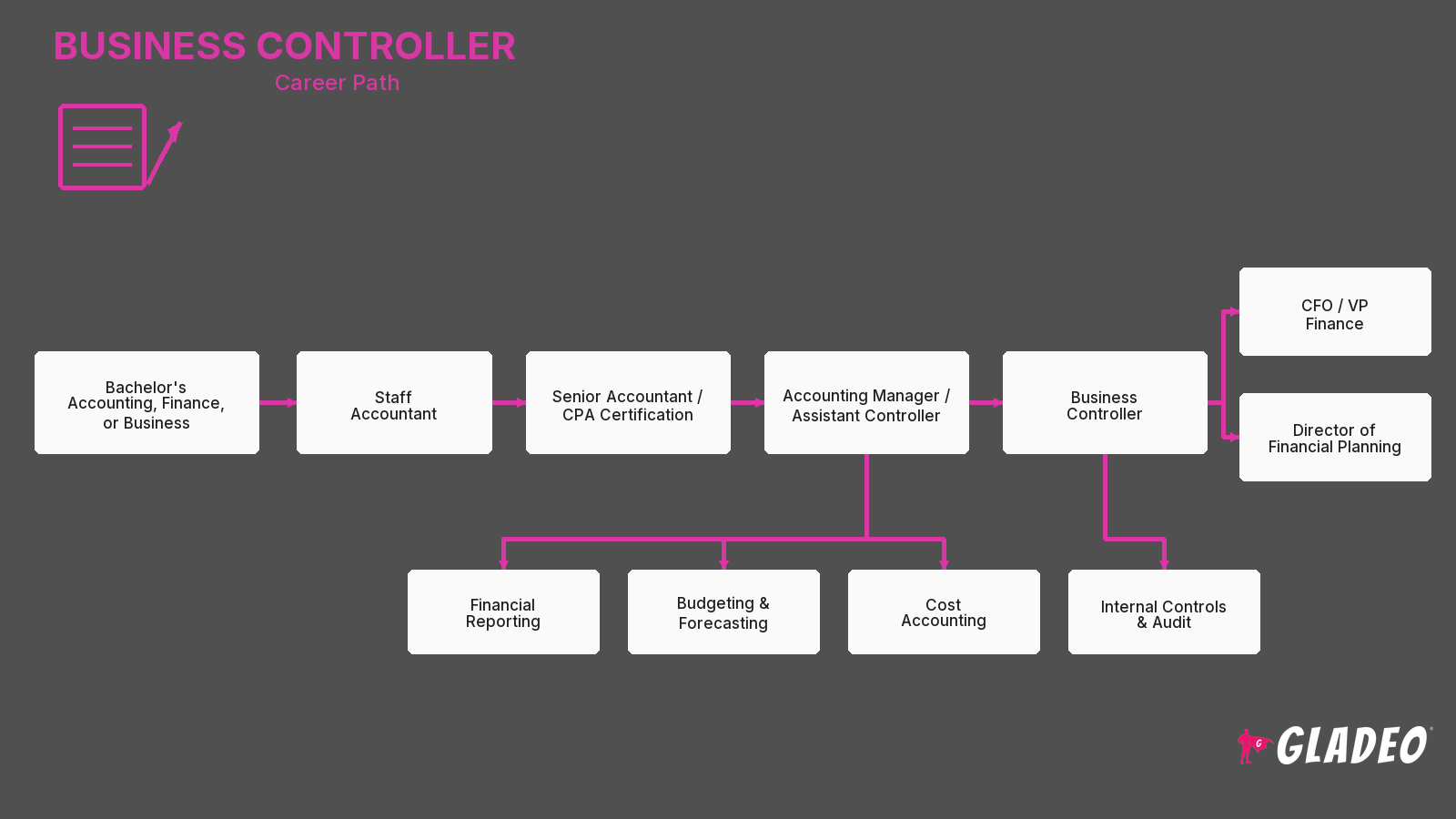
Becoming a Business Controller usually requires a bachelor’s degree in finance, accounting, business administration, or a related field. Many also pursue advanced certifications or master’s degrees to deepen their expertise and improve career prospects.
Students can take courses in relevant subjects such as:
- Accounting Principles
- Corporate Finance
- Business Statistics
- Financial Reporting and Analysis
- Management Accounting
- Economics
- Data Analytics for Business
- Budgeting and Forecasting
- Risk Management
- Information Systems in Finance
Hands-on experience through internships or cooperative education programs is critical to developing practical skills. Building a strong portfolio of financial analyses and reports can set candidates apart. On-the-job training and continuous professional development are also key to advancing in this dynamic field.
- Take advanced math courses including algebra, statistics, and calculus.
- Enroll in business and economics classes if available.
- Develop strong computer skills, especially in spreadsheet and presentation software.
- Join math or finance clubs to practice problem-solving and teamwork.
- Seek internships or part-time jobs in accounting or finance departments.
- Participate in competitions like DECA or Junior Achievement.
- Attend college preparatory programs focused on business and economics.
- Network with professionals through school career days or online platforms.
- Consider summer programs or workshops on financial literacy.
- Build a portfolio of projects related to budgeting or financial planning.
- Look for programs accredited by recognized business education bodies.
- Choose schools with strong industry connections and internship opportunities.
- Seek courses that combine accounting, finance, and data analytics.
- Prioritize programs offering hands-on experience with financial software.
- Check if faculty have professional certifications and real-world experience.
- Explore programs that teach current financial regulations and compliance.
- Consider dual degrees or minors in information systems or economics.
- Look for small class sizes to get personalized attention.
- Find institutions offering career counseling and job placement support.
- Prefer programs that encourage participation in case studies and simulations.
- Verify the availability of student organizations focused on finance and business.
- Choose schools with active alumni networks in the finance industry.
- Apply for internships or entry-level roles like financial analyst or accounting assistant.
- Build a portfolio showcasing budgeting, forecasting, and financial reporting skills.
- Network with professionals through LinkedIn and industry events.
- Seek mentorship from experienced Business Controllers or finance managers.
- Develop proficiency in Excel and financial software tools.
- Practice preparing clear, concise reports and presentations.
- Stay updated on financial regulations and industry news.
- Volunteer for cross-departmental projects to gain broader business insight.
- Work on improving communication skills to translate financial data for non-finance colleagues.
- Prepare for interviews by studying common finance scenarios and problem-solving questions.
- Attend workshops or webinars on business control and financial management.
- Consider certifications like CFA, CPA, or CMA as long-term goals.
- Master advanced financial modeling and data analysis techniques.
- Gain experience managing larger budgets and more complex projects.
- Build strong relationships with senior management and cross-functional teams.
- Earn professional certifications like CPA, CMA, or CFA to increase credibility.
- Take leadership roles in finance teams or special projects.
- Stay informed about emerging financial technologies and regulations.
- Develop strategic thinking beyond numbers to influence business decisions.
- Seek opportunities to work internationally or across different industries.
Websites:
- Association of Certified Fraud Examiners (ACFE) - acfe.com
- Institute of Management Accountants (IMA) - ima.org
- Financial Executives International (FEI) - financialexecutives.org
- Chartered Institute of Management Accountants (CIMA) - cima.com
- Corporate Finance Institute (CFI) - corporatefinanceinstitute.com
- American Institute of CPAs (AICPA) - aicpa.org
- Project Management Institute (PMI) - pmi.org
- Finance Training Center - financetrainingcenter.com
- Accounting Today - accountingtoday.com
- Wall Street Journal - wsj.com
- Investopedia - investopedia.com
- LinkedIn Learning - linkedin.com/learning
- Coursera - coursera.org
- Udemy - udemy.com
Books:
- Financial Intelligence by Karen Berman and Joe Knight
- The Controller’s Function by Steven M. Bragg
- Cost Accounting: A Managerial Emphasis by Charles T. Horngren
- Corporate Finance by Jonathan Berk and Peter DeMarzo
- The Essentials of Finance and Accounting for Nonfinancial Managers by Edward Fields
If becoming a Business Controller isn’t the right fit, there are plenty of related careers where your financial skills and business savvy can shine.
- Financial Analyst
- Accountant
- Budget Analyst
- Internal Auditor
- Risk Manager
- Management Consultant
- Treasury Analyst
- Cost Estimator
- Operations Manager
- Data Analyst
Newsfeed

Featured Jobs
Online Courses and Tools