






Spotlights
Data Analyst, Business Data Analyst, BI Analyst, Data Insights Analyst, Reporting Analyst, Analytics Consultant, Data Strategist, Business Systems Analyst, Data Mining Analyst, Decision Support Analyst, Data Visualization Specialist, Business Analytics Specialist
Imagine being the person who turns mountains of confusing data into clear, powerful stories that help companies and organizations make smarter decisions. Business Intelligence Analysts transform raw information into insights that can improve everything from customer satisfaction to government services.
Every day, Business Intelligence Analysts dive into data collected from sales, operations, finance, or public programs. They collaborate closely with managers, IT teams, and stakeholders to understand what questions need answers. Their work involves designing reports, dashboards, and visualizations that highlight trends and opportunities, helping their teams act on facts rather than guesswork.
Using powerful software tools like SQL, Tableau, and Power BI, Business Intelligence Analysts gather, clean, and model data to reveal patterns. Their role is vital because the insights they provide guide strategy, improve efficiency, and solve complex problems in business and public sectors alike.
- Seeing how your data insights directly influence important business or community decisions.
- Transforming complex numbers into visual stories that anyone can understand and use.
- Collaborating with diverse teams to solve real-world problems through information.
- Continuously learning new tools and techniques to stay ahead in the data-driven world.
Working Schedule
Business Intelligence Analysts typically work full-time in office settings, often during regular business hours. Deadlines can be tight, especially when projects are tied to quarterly reports or major launches, so some overtime or flexible hours may be necessary. Many analysts work as part of a team within a company’s IT or strategy department, but some take on freelance or consulting roles, offering their expertise to multiple clients.
Typical Duties
- Collect and organize data from various sources including databases and spreadsheets.
- Analyze data to identify trends, patterns, and anomalies.
- Develop and maintain dashboards and visual reports for stakeholders.
- Use SQL and other query languages to extract relevant data.
- Collaborate with managers and departments to understand data needs.
- Present findings in clear, actionable ways using charts and graphs.
- Ensure data accuracy and integrity by cleaning and validating information.
- Stay up-to-date with the latest BI tools and data visualization techniques.
- Create predictive models to forecast future trends or outcomes.
- Document processes and methodologies for data analysis.
- Train colleagues on how to interpret BI reports and dashboards.
- Monitor performance metrics to evaluate business initiatives.
Additional Responsibilities
- Troubleshoot and resolve data inconsistencies or errors.
- Work with IT teams to improve data collection and storage systems.
- Support decision-making by providing timely data insights.
- Assist in developing data governance policies.
- Contribute to strategic planning with data-driven recommendations.
- Manage user access and permissions for BI platforms.
- Participate in cross-functional project teams to align BI efforts.
- Continuously optimize reporting processes for efficiency.
In the morning, a Business Intelligence Analyst reviews emails and checks dashboards for any overnight updates or anomalies. They might start the day by meeting with department heads to discuss what data questions need to be addressed or to clarify project goals.
Midday involves deep focus on data extraction and analysis. The analyst writes complex queries, cleans data sets, builds visualizations, and tests predictive models. They also attend collaborative sessions with IT and business teams to align the analysis with strategic objectives.
Later in the day, they prepare reports and presentations explaining their findings in simple terms. They might train colleagues on using BI tools or troubleshoot data issues. As deadlines approach, the pace can increase, with quick turnarounds on last-minute data requests or revisions.
Soft Skills
- Critical thinking
- Problem-solving
- Communication
- Attention to detail
- Collaboration
- Time management
- Adaptability
- Curiosity
- Storytelling with data
- Patience
- Active listening
- Presentation skills
Technical Skills
- SQL querying
- Data visualization (Tableau, Power BI, etc.)
- Data cleaning and preparation
- Excel advanced functions
- Statistical analysis
- Database management
- Predictive modeling
- Scripting languages (Python, R)
- Dashboard design
- ETL (Extract, Transform, Load) processes
- Financial BI Analyst: Focuses on financial data to improve budgeting and forecasting.
- Healthcare BI Analyst: Works with patient and treatment data to optimize care delivery.
- Marketing BI Analyst: Analyzes campaign and customer data to boost engagement.
- Sales BI Analyst: Tracks sales trends and performance to drive revenue growth.
- Operations BI Analyst: Examines internal processes to increase efficiency.
- Government BI Analyst: Supports public programs by analyzing policy impacts and service usage.
- E-commerce BI Analyst: Monitors online shopping behaviors and website metrics.
- Manufacturing BI Analyst: Uses production data to reduce costs and improve quality.
- Large corporations
- Government agencies
- Healthcare providers
- Financial institutions
- Marketing and advertising firms
- Non-profit organizations
- Technology companies
- Retail chains
- Consulting agencies
- Educational institutions
- Manufacturing companies
- E-commerce businesses
Business Intelligence Analysts often face pressure to deliver accurate insights on tight deadlines, especially when reports impact major business decisions. This requires focus and the ability to manage multiple projects simultaneously.
Typical work hours are standard business hours, but urgent requests or end-of-quarter reports can extend the day. Analysts need to be flexible and sometimes put in extra time to meet critical deadlines.
The role demands a balance between detailed technical work and clear communication. Analysts must handle repetitive data tasks while staying creative in problem-solving and storytelling. Patience and perseverance are essential, especially when working with imperfect or messy data.
- Increasing use of artificial intelligence and machine learning to automate data analysis.
- Growing demand for real-time data dashboards and live reporting.
- Integration of BI tools with cloud computing platforms.
- Expansion of self-service BI tools empowering non-technical users.
- Focus on data privacy and compliance with regulations like GDPR.
- Emphasis on data storytelling to make insights accessible.
- Use of predictive and prescriptive analytics to forecast trends.
- Rise in mobile BI applications for on-the-go insights.
- Consolidation of multiple data sources into unified platforms.
- Adoption of augmented analytics enhancing human decision-making.
Many Business Intelligence Analysts enjoyed puzzles, logic games, and problem-solving activities as kids, showing an early love for patterns and analysis. They often liked organizing information or figuring out how things work behind the scenes.
They were curious about numbers and technology, frequently experimenting with computers or exploring statistics in school. Their natural tendency to ask 'why' and dig deeper set the stage for their future career in data-driven decision making.
Business Intelligence Analysts typically pursue a bachelor’s degree in fields like computer science, information systems, business administration, or statistics. Some also enhance their skills with specialized certifications or graduate degrees focused on analytics or data science.
Students can take courses in relevant subjects such as:
- Statistics
- Computer Programming (Python, R)
- Database Management
- Data Mining
- Business Analytics
- Information Systems
- Mathematics (Algebra, Calculus)
- Data Visualization Techniques
- Economics
- Project Management
Hands-on experience through internships or projects is crucial to build a strong portfolio. Many employers value candidates who demonstrate practical skills with BI tools and data storytelling. Continuous learning is important as technology and methods evolve rapidly.
- Take advanced math courses such as algebra and statistics.
- Enroll in computer science or programming classes if available.
- Join clubs or activities focused on technology, business, or data (e.g., coding clubs, DECA).
- Practice analyzing data sets or working on school projects involving research and reporting.
- Learn to use spreadsheet software like Microsoft Excel.
- Explore online tutorials for BI tools like Tableau or Power BI.
- Participate in internships or volunteer for roles involving data collection or analysis.
- Develop strong writing and presentation skills for sharing insights.
- Attend workshops or summer camps focused on technology and analytics.
- Network with professionals through school career fairs or online platforms.
- Look for programs offering courses in both business and technology.
- Choose schools with access to modern BI software and labs.
- Seek programs that provide internships or co-op opportunities.
- Find programs with faculty experienced in data science and analytics.
- Consider certifications in SQL, Tableau, or Power BI alongside your degree.
- Ensure curriculum covers statistics, database management, and programming.
- Check for student projects involving real-world data analysis.
- Prioritize programs that teach data storytelling and visualization.
- Look for flexible learning options including online courses.
- Explore degree programs that integrate ethics and data privacy education.
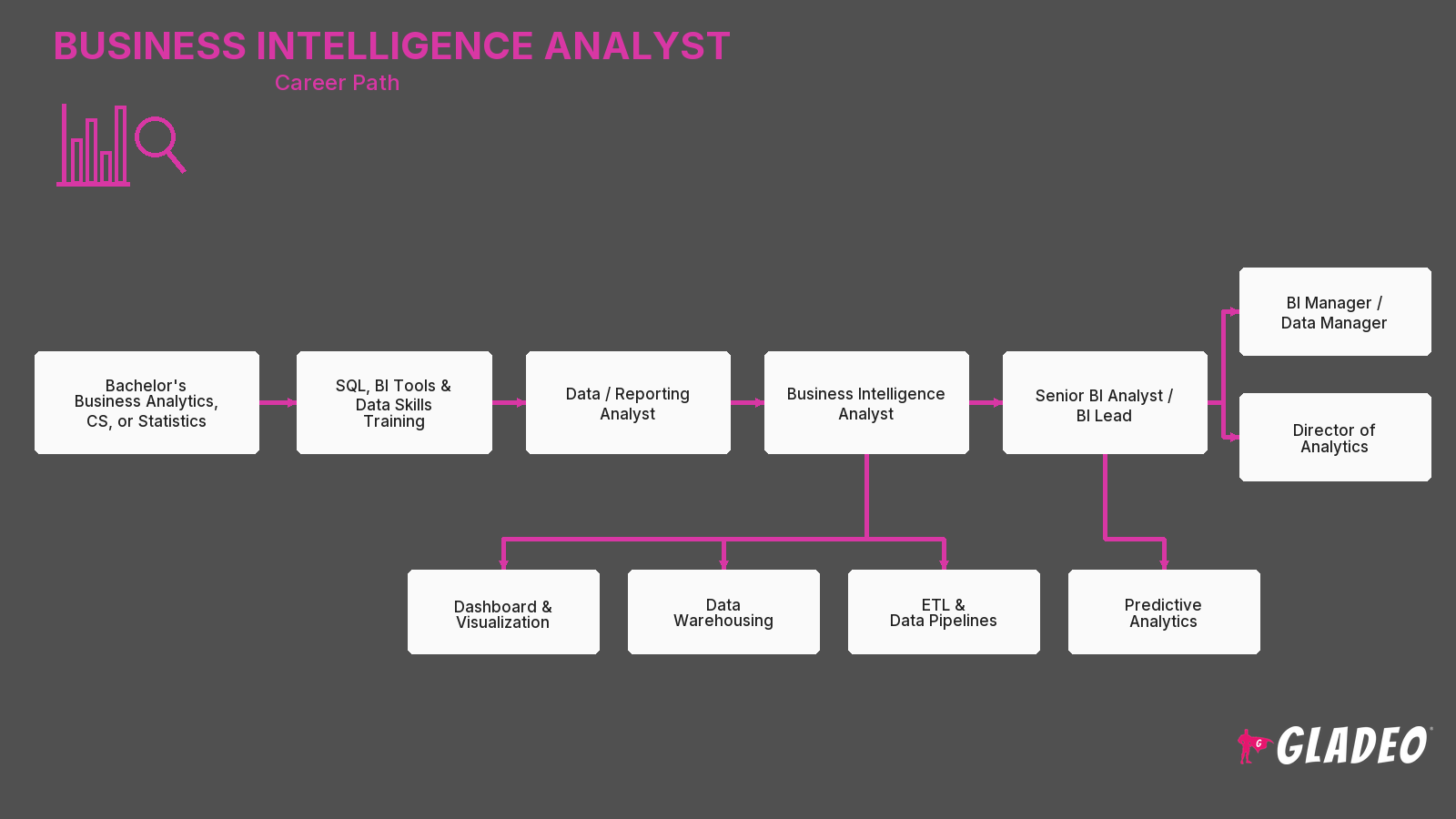
- Build a portfolio showcasing data projects and visualizations.
- Apply for internships or entry-level analyst roles in diverse industries.
- Learn SQL and popular BI tools like Tableau or Power BI on your own time.
- Network with professionals via LinkedIn or industry groups.
- Attend data science or business analytics meetups and workshops.
- Prepare for interviews by practicing explaining complex data simply.
- Seek mentorship from experienced analysts or data scientists.
- Stay current with the latest BI trends and software updates.
- Volunteer for data-related projects in school or community organizations.
- Develop strong communication skills to present findings effectively.
- Practice problem-solving with real or simulated business cases.
- Be willing to start with junior or support roles to gain experience.
- Master advanced analytics and machine learning techniques.
- Develop expertise in specialized industries (finance, healthcare, etc.).
- Build leadership skills to manage BI teams or projects.
- Earn professional certifications like Certified Business Intelligence Professional (CBIP).
- Expand knowledge of data governance and compliance.
- Lead cross-departmental initiatives using BI insights.
- Stay active in professional organizations and conferences.
- Consider advanced degrees such as a Master’s in Data Science or Business Analytics.
Websites:
- TDWI (Transforming Data With Intelligence) - tdwi.org
- Gartner - gartner.com
- Tableau Community - community.tableau.com
- Microsoft Power BI Community - community.powerbi.com
- Data Visualization Society - datavizsociety.com
- International Institute of Business Analysis (IIBA) - iiba.org
- Kaggle - kaggle.com
- Analytics Vidhya - analyticsvidhya.com
- Business Intelligence Group - bibusinessgroup.com
- DataCamp - datacamp.com
- LinkedIn Learning - linkedin.com/learning
- Coursera - coursera.org
- Udacity - udacity.com
- IBM Data and AI - ibm.com/analytics
Books:
- Data Science for Business by Foster Provost and Tom Fawcett
- Storytelling with Data by Cole Nussbaumer Knaflic
- The Data Warehouse Toolkit by Ralph Kimball and Margy Ross
- Business Intelligence Guidebook by Rick Sherman
- Naked Statistics by Charles Wheelan
If a career as a Business Intelligence Analyst doesn't seem like the right fit, there are plenty of related roles where your skills with data, analysis, and business could shine.
- Data Scientist
- Data Analyst
- Operations Analyst
- Market Research Analyst
- Financial Analyst
- Database Administrator
- Management Consultant
- Systems Analyst
- Project Manager
- Quality Assurance Analyst
Newsfeed

Featured Jobs
Online Courses and Tools