






Spotlights
Evolutionary Scientist, Evolutionary Ecologist, Evolutionary Geneticist, Evolutionary Anthropologist, Evolutionary Paleobiologist, Population Biologist, Molecular Evolutionist, Phylogeneticist, Behavioral Evolutionist, Evolutionary Theorist, Evolutionary Developmental Biologist
Every living creature on Earth carries a story written in its DNA, shaped by millions of years of change, survival, and adaptation. Evolutionary Biologists unlock these stories to help us understand how life has transformed and how it continues to evolve in response to our changing world.
Evolutionary Biologists study the processes that drive the diversity of life by researching genetics, fossils, behaviors, and ecosystems. They collect data from lab experiments, field observations, and computer models, collaborating with geneticists, ecologists, paleontologists, and environmental scientists to uncover how species develop, adapt, or go extinct. Their work helps answer big questions about life’s past and predicts how organisms might respond to future environmental pressures.
Using tools like genome sequencers, statistical software, and phylogenetic trees, Evolutionary Biologists analyze genetic material and evolutionary relationships to reveal patterns of change over time. Their research informs conservation efforts, medical advances, and our understanding of biodiversity, making this role crucial for protecting life on Earth and advancing science.
- Discovering how life’s complex history connects every species on the planet.
- Contributing knowledge that helps conserve endangered species and ecosystems.
- Solving puzzles about how traits and behaviors evolved over time.
- Working with cutting-edge technology and diverse scientific teams to push the boundaries of biological science.
Working Schedule
Evolutionary Biologists typically work full-time in laboratories, universities, or field sites. Their schedule can vary depending on research demands, with fieldwork sometimes requiring irregular or extended hours outdoors. Academic or research positions follow a more predictable routine but may involve deadlines for publishing and grant applications. Freelance or consulting roles might offer flexible hours but include project-based pressure.
Typical Duties
- Design and conduct experiments to test hypotheses about evolution and adaptation.
- Collect and analyze genetic, fossil, or behavioral data from species in labs or field.
- Use computer models to simulate evolutionary processes and predict future changes.
- Collaborate with other scientists, such as geneticists and ecologists, to integrate multidisciplinary data.
- Publish research findings in scientific journals and present at conferences.
- Develop conservation strategies based on evolutionary insights for endangered species.
- Teach and mentor students in universities or research institutions.
- Stay updated on scientific advancements and new technologies in evolutionary biology.
- Secure funding through grant writing to support research projects.
- Maintain and manage laboratory or field equipment and specimens.
- Interpret complex datasets to draw conclusions about species’ evolutionary history.
- Advise policymakers or conservation groups using evolutionary evidence.
Additional Responsibilities
- Supervise undergraduate or graduate research assistants.
- Peer-review manuscripts submitted to scientific journals.
- Participate in public outreach to explain evolutionary concepts.
- Contribute to interdisciplinary research teams on environmental or health issues.
- Develop educational materials or curricula for schools or museums.
- Attend workshops and training to enhance research skills.
- Ensure compliance with ethical standards in research involving animals or genetic data.
- Manage budgets and timelines for research grants or projects.
Mornings often start with reviewing data collected from field studies or lab experiments, checking results for patterns or anomalies that inform the day’s research focus.
By midday, Evolutionary Biologists analyze genetic sequences or fossil records using specialized software, interpreting evolutionary relationships and testing hypotheses alongside colleagues.
Afternoons may include meetings with research teams to discuss findings, planning upcoming fieldwork, mentoring students, or preparing presentations and manuscripts for publication deadlines.
Soft Skills
- Curiosity and passion for understanding life’s history
- Critical thinking to evaluate complex scientific problems
- Attention to detail in data collection and analysis
- Strong communication skills for writing and presenting
- Collaboration across diverse scientific disciplines
- Patience and perseverance during long-term studies
- Adaptability to changing research conditions and methods
- Problem-solving to design experiments and interpret data
- Time management to balance research, teaching, and publication
- Ethical judgment in conducting and reporting research
- Creativity in developing innovative research questions
- Resilience to handle setbacks or unexpected results
Technical Skills
- Proficiency with genetic sequencing technologies
- Competence in statistical and data analysis software (e.g., R, Python)
- Skill in phylogenetic tree construction and interpretation
- Experience with ecological modeling and simulations
- Ability to use lab equipment for DNA extraction and analysis
- Familiarity with fossil identification and paleontological methods
- Knowledge of bioinformatics tools and databases
- Capability to design and conduct controlled experiments
- Competence in scientific writing and grant proposal development
- Experience with geographic information systems (GIS)
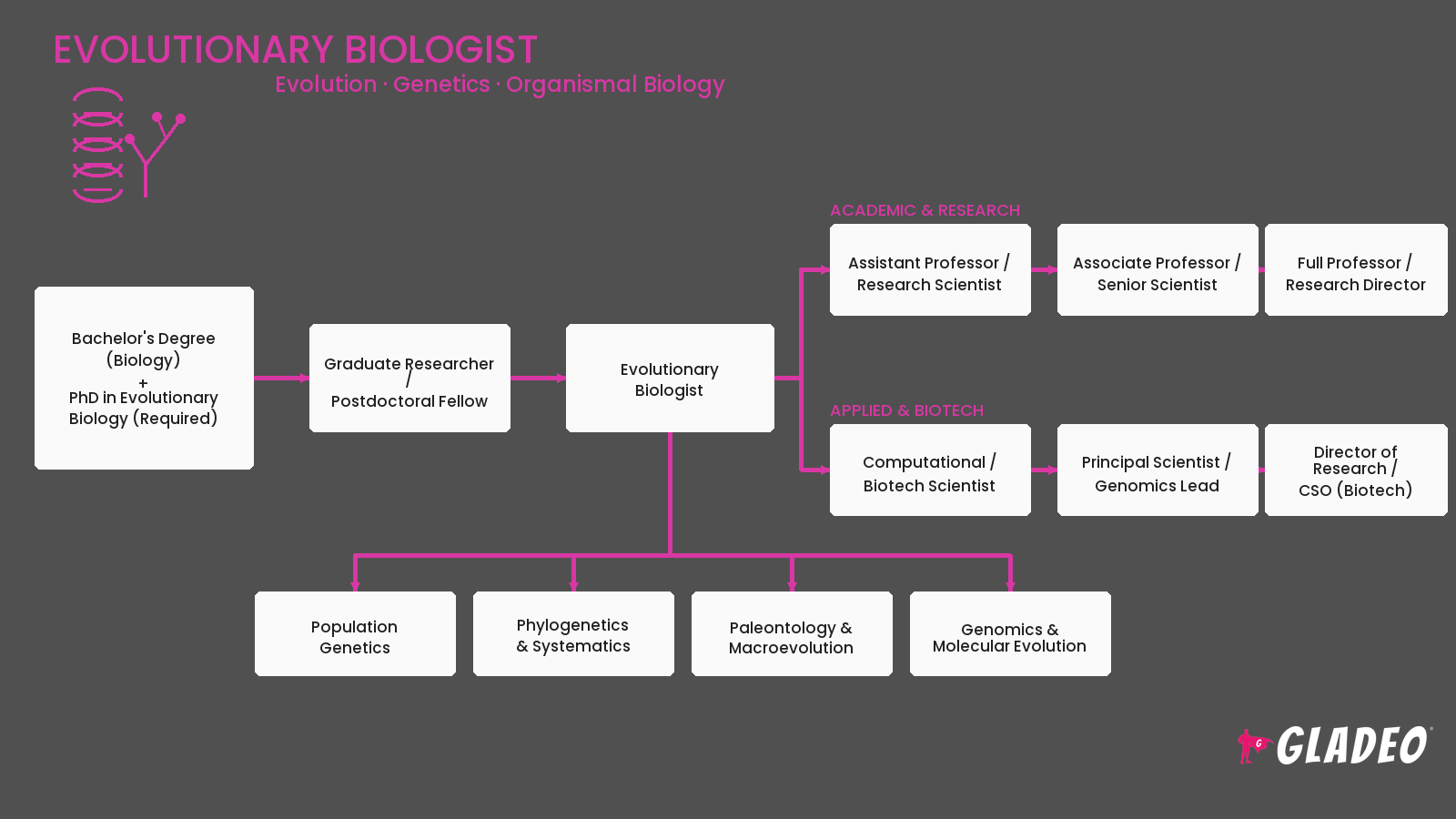
- Molecular Evolutionary Biologist: Focuses on genetic and molecular mechanisms driving evolution.
- Evolutionary Ecologist: Studies how evolutionary processes affect ecological interactions and ecosystems.
- Paleobiologist: Investigates fossil records to understand ancient life and evolutionary history.
- Behavioral Evolutionist: Examines how behaviors evolve and influence survival and reproduction.
- Phylogeneticist: Constructs evolutionary trees to map relationships among species.
- Evolutionary Developmental Biologist (Evo-Devo): Explores how developmental processes influence evolutionary changes.
- Population Biologist: Analyzes genetic variation and evolution within and between populations.
- Conservation Evolutionary Biologist: Applies evolutionary principles to protect species and habitats.
- Universities and Academic Research Centers
- Government Research Agencies (e.g., National Science Foundation)
- Environmental Conservation Organizations
- Biotechnology Companies
- Museums of Natural History
- Wildlife and Habitat Management Agencies
- Scientific Journals and Publishers
- Nonprofit Environmental Advocacy Groups
- Agricultural Research Institutions
- Pharmaceutical Research Labs
- Science Museums and Educational Institutions
- International Research Collaborations
Evolutionary Biologists often face pressure to publish research findings and secure funding through competitive grants, which can create stressful deadlines and demand high productivity.
Fieldwork can involve physically demanding conditions, remote locations, and unpredictable weather, requiring flexibility and resilience.
Balancing research, teaching responsibilities, and administrative duties often means long hours and dedication beyond a typical 9-to-5 schedule, especially in academia.
- Advances in genome sequencing technologies enabling deeper insights into genetic evolution.
- Increasing use of computational models and AI to simulate evolutionary processes.
- Growing emphasis on conservation biology to address biodiversity loss.
- Integration of evolutionary biology with medicine to understand diseases and treatments.
- Expansion of interdisciplinary research combining genetics, ecology, and behavior.
- Development of citizen science projects to collect large-scale evolutionary data.
- Use of CRISPR and gene-editing tools to study evolutionary mechanisms.
- Greater focus on climate change’s impact on evolutionary dynamics.
- Open-access data sharing accelerating collaborative research.
- Rising importance of evolutionary biology in agriculture and sustainable food production.
Many Evolutionary Biologists showed a keen interest in nature, animals, and science from a young age, often exploring outdoors, collecting specimens, or reading about dinosaurs and natural history.
They enjoyed puzzles and problem-solving activities, demonstrating curiosity about how living things change over time and how different species are related.
Becoming an Evolutionary Biologist usually involves earning a bachelor’s degree in biology, ecology, genetics, or a related field, followed by graduate studies specializing in evolutionary biology. Hands-on research experience through internships or lab work is essential to build skills and a strong portfolio.
Students can take courses in relevant subjects such as:
- Biology and Ecology
- Genetics and Molecular Biology
- Evolutionary Theory
- Statistics and Data Analysis
- Paleontology and Fossil Study
- Field Research Methods
- Bioinformatics
- Animal Behavior
- Environmental Science
- Scientific Writing and Communication
Advanced degrees (master’s or Ph.D.) are often required for research or university positions. Participating in research projects, publishing papers, and gaining experience with cutting-edge lab and field techniques are key to success in this career.
- Join science clubs or biology-focused extracurriculars.
- Participate in science fairs with evolutionary biology projects.
- Take advanced courses in biology, chemistry, and math.
- Volunteer or intern at museums, wildlife centers, or research labs.
- Practice computer skills, especially in data analysis and programming.
- Attend lectures or workshops on genetics and evolution.
- Read scientific articles and popular science books about evolution.
- Develop strong writing skills by reporting on science topics.
- Seek mentorship from biology teachers or university researchers.
- Explore summer programs or camps focused on natural sciences.
- Look for programs with strong biology and genetics coursework.
- Choose schools offering research opportunities or internships.
- Find programs with faculty specializing in evolutionary biology.
- Ensure access to modern lab facilities and fieldwork options.
- Consider programs encouraging interdisciplinary studies in ecology and genetics.
- Check for opportunities to participate in conferences and publish research.
- Look for mentorship and support for graduate school applications.
- Find programs that teach bioinformatics and computational biology.
- Seek out programs with collaborations with museums or conservation groups.
- Evaluate the balance between theoretical and hands-on learning.
- Apply for research assistant positions in university labs or government agencies.
- Build a portfolio of research projects and publications.
- Network with professionals through scientific conferences and workshops.
- Seek internships in museums, environmental organizations, or biotechnical firms.
- Volunteer for fieldwork opportunities to gain practical experience.
- Develop skills in data analysis software and lab techniques.
- Create a strong CV highlighting relevant coursework and research experience.
- Prepare for interviews by practicing explanations of your research interests.
- Join professional societies to access job listings and mentoring.
- Consider entry-level roles in related fields like ecology or genetics to build experience.
- Maintain relationships with mentors and advisors for recommendations.
- Stay current on scientific literature and emerging technologies.
- Pursue graduate degrees (Master’s and Ph.D.) to specialize and qualify for advanced roles.
- Publish research regularly to build credibility in the scientific community.
- Expand your network by attending conferences and collaborating internationally.
- Seek leadership roles in research projects or academic departments.
- Develop grant writing skills to secure funding for your work.
- Gain teaching experience to advance in academic careers.
- Stay current with new technologies and methodologies in evolutionary biology.
- Consider roles in science communication or policy to broaden impact.
Websites:
- Society for the Study of Evolution (evolutionsociety.org)
- American Society of Naturalists (amnat.org)
- National Evolutionary Synthesis Center (nescent.org)
- Ecological Society of America (esa.org)
- National Geographic Education (education.nationalgeographic.org)
- Smithsonian Institution (si.edu)
- Nature Education (nature.com/nature-education)
- BioMed Central Evolutionary Biology Journal (bmcevolbiol.biomedcentral.com)
- Evolution Institute (evolution-institute.org)
- PLOS Biology (journals.plos.org/plosbiology)
- Science Careers (sciencecareers.org)
- The Paleontological Society (paleosoc.org)
- Genetics Society of America (genetics-gsa.org)
- •Conservation International (conservation.org)
Books:
- The Selfish Gene by Richard Dawkins
- Your Inner Fish by Neil Shubin
- Evolution: The Triumph of an Idea by Carl Zimmer
- The Greatest Show on Earth by Richard Dawkins
- Why Evolution is True by Jerry A. Coyne
If becoming an Evolutionary Biologist doesn't work out or you want to explore related paths, there are several careers that use similar skills and knowledge about biology and research.
- Ecologist
- Genetic Counselor
- Wildlife Biologist
- Conservation Scientist
- Biomedical Researcher
- Science Educator
- Environmental Consultant
- Science Writer or Journalist
- Paleontologist
- Bioinformatics Specialist
Newsfeed

Featured Jobs
Online Courses and Tools