






Spotlights
Agricultural Extension Specialist, Community Outreach Coordinator, Farm Advisor, Rural Development Agent, Agricultural Educator, Cooperative Extension Agent, Agricultural Consultant, Livestock Extension Officer, Crop Advisor, Horticultural Extension Agent, Agricultural Outreach Specialist, Natural Resources Extension Agent
The work of Extension Agents touches the lives of farmers, families, and communities by bringing research-based knowledge directly to those who need it most. Whether it's helping a family improve crop yields, advising on sustainable farming practices, or supporting youth education in agriculture, these professionals make a real difference in everyday lives and local economies.
Extension Agents spend their days connecting with farmers, ranchers, gardeners, and community members to share the latest scientific research and practical advice. They collaborate with universities, government agencies, and local organizations to develop programs that address specific agricultural, environmental, and community challenges. Their goal is to improve productivity, sustainability, and quality of life through education and outreach.
Using tools like soil analysis kits, data management software, and communication platforms, Extension Agents translate complex research into clear, actionable guidance. Their role is vital because they bridge the gap between science and practice, ensuring that innovations in agriculture and natural resource management reach the people who can put them to work effectively.
- Helping farmers and families improve their livelihoods through practical advice and education.
- Seeing communities thrive as they adopt sustainable and efficient agricultural practices.
- Building strong relationships and trust within rural and urban communities.
- Contributing directly to environmental conservation and food security efforts.
Working Schedule
Extension Agents usually work full-time and spend much of their time in the field visiting farms, community centers, or schools, as well as in the office preparing programs and reports. Their schedules can vary with the seasons, often busier during planting and harvest times. Some positions are government-funded and may require occasional evening or weekend workshops to meet community needs.
Typical Duties
- Conducting workshops and training sessions on crop management, livestock care, pest control, and sustainable practices.
- Visiting farms and agricultural sites to provide hands-on advice and troubleshoot problems.
- Developing educational materials, including pamphlets, videos, and online content tailored to local needs.
- Collaborating with university researchers to stay updated on the latest agricultural science.
- Assisting farmers in applying for grants and government programs.
- Collecting and analyzing data on soil health, pest populations, and crop performance.
- Organizing community events and youth programs like 4-H clubs or school gardens.
- Advising on natural resource management and conservation techniques.
- Communicating program results to stakeholders and funding agencies.
- Maintaining detailed records of outreach activities and participant feedback.
Additional Responsibilities
- Networking with local government officials and agricultural organizations to support community initiatives.
- Evaluating the effectiveness of educational programs and adjusting strategies accordingly.
- Promoting sustainable agriculture and environmental stewardship.
- Mentoring new Extension Agents or interns.
- Managing budgets for community projects.
- Responding to emergency situations like pest outbreaks or natural disasters affecting agriculture.
- Advocating for farmers and community members in policy discussions.
- Ensuring compliance with health and safety regulations during outreach activities.
Mornings often start with reviewing emails and preparing materials for upcoming workshops or farm visits. Extension Agents might plan a training session on soil conservation or prepare handouts about pest management techniques.
Midday is frequently spent traveling to farms or community sites, meeting with clients to assess their needs, and providing tailored advice. They may collect samples, observe conditions, or demonstrate new equipment or practices directly in the field.
Afternoons are reserved for collaborating with colleagues, entering data, and following up on previous visits. Evening hours might involve hosting community meetings or youth programs, answering questions, and gathering feedback to improve future outreach efforts.
Soft Skills
- Strong communication and public speaking abilities
- Patience and empathy when working with diverse populations
- Problem-solving and critical thinking
- Adaptability to changing environments and schedules
- Collaboration and teamwork
- Cultural sensitivity and respect for local traditions
- Organization and time management
- Leadership and mentoring skills
- Conflict resolution
- Community engagement and relationship building
- Active listening
- Creativity in educational program design
Technical Skills
- Basic knowledge of agricultural science and biology
- Data collection and analysis
- Use of soil and plant testing equipment
- Familiarity with GIS and mapping software
- Proficiency with presentation and educational software
- Grant writing and reporting
- Use of social media and digital communication tools
- Understanding of pest management and crop production techniques
- Ability to interpret scientific research and translate it for lay audiences
- Record-keeping and database management
- Crop Extension Agent: Focuses on improving crop production, pest control, and soil management techniques.
- Livestock Extension Agent: Specializes in animal health, nutrition, breeding, and husbandry practices.
- Community Development Agent: Works on broader community issues including economic development, health, and youth education linked to agriculture.
- Natural Resources Extension Agent: Focuses on conservation, water management, and sustainable land use.
- Horticultural Extension Agent: Advises on gardening, landscape plants, and specialty crops.
- Youth Extension Agent: Concentrates on educational programs for children and teens such as 4-H and FFA clubs.
- Specialty Crop Advisor: Provides expertise on specific crops like fruits, vegetables, or nuts.
- Agricultural Technology Extension Agent: Promotes the adoption of new farming technologies and precision agriculture.
- Land-grant universities
- State and county agricultural departments
- Cooperative Extension Services
- Nonprofit agricultural organizations
- Farm bureaus and commodity groups
- Environmental conservation agencies
- Local government offices
- Agricultural research centers
- 4-H clubs and youth organizations
- Community colleges with agricultural programs
- Agricultural consulting firms
- International development agencies
Extension Agents often face pressure to meet the diverse needs of farmers and community members while managing limited resources. They must stay current with rapidly evolving agricultural science and adapt programs to fit local conditions, which requires continuous learning and flexibility.
The job can involve long hours, especially during peak farming seasons or when organizing community events. Fieldwork may expose them to varying weather and physical demands, and they need to balance office work with active outreach.
Sacrifices include irregular schedules, travel away from home, and sometimes dealing with resistance to change from clients. However, the reward of seeing positive community impact often outweighs these challenges.
- Increasing use of digital tools like mobile apps and remote sensing for farm management.
- Growing emphasis on sustainable and regenerative agriculture practices.
- Expansion of online workshops and virtual outreach programs.
- Integration of precision agriculture technology into extension services.
- Focus on climate change adaptation and resilience for farmers.
- Greater collaboration between universities, government, and private sectors.
- Rising interest in urban agriculture and community gardening.
- Development of tailored programs for diverse cultural and linguistic communities.
- Use of social media to engage younger audiences and share information.
- Emphasis on data-driven decision making and program evaluation.
Many successful Extension Agents enjoyed spending time outdoors, gardening, or helping on family farms as children. They were often curious about how plants grow and interested in science or nature from an early age.
They also showed a passion for teaching and helping others, whether through school clubs, community service, or leading youth groups. Early involvement in programs like 4-H or FFA often sparked their interest in agricultural education and community development.
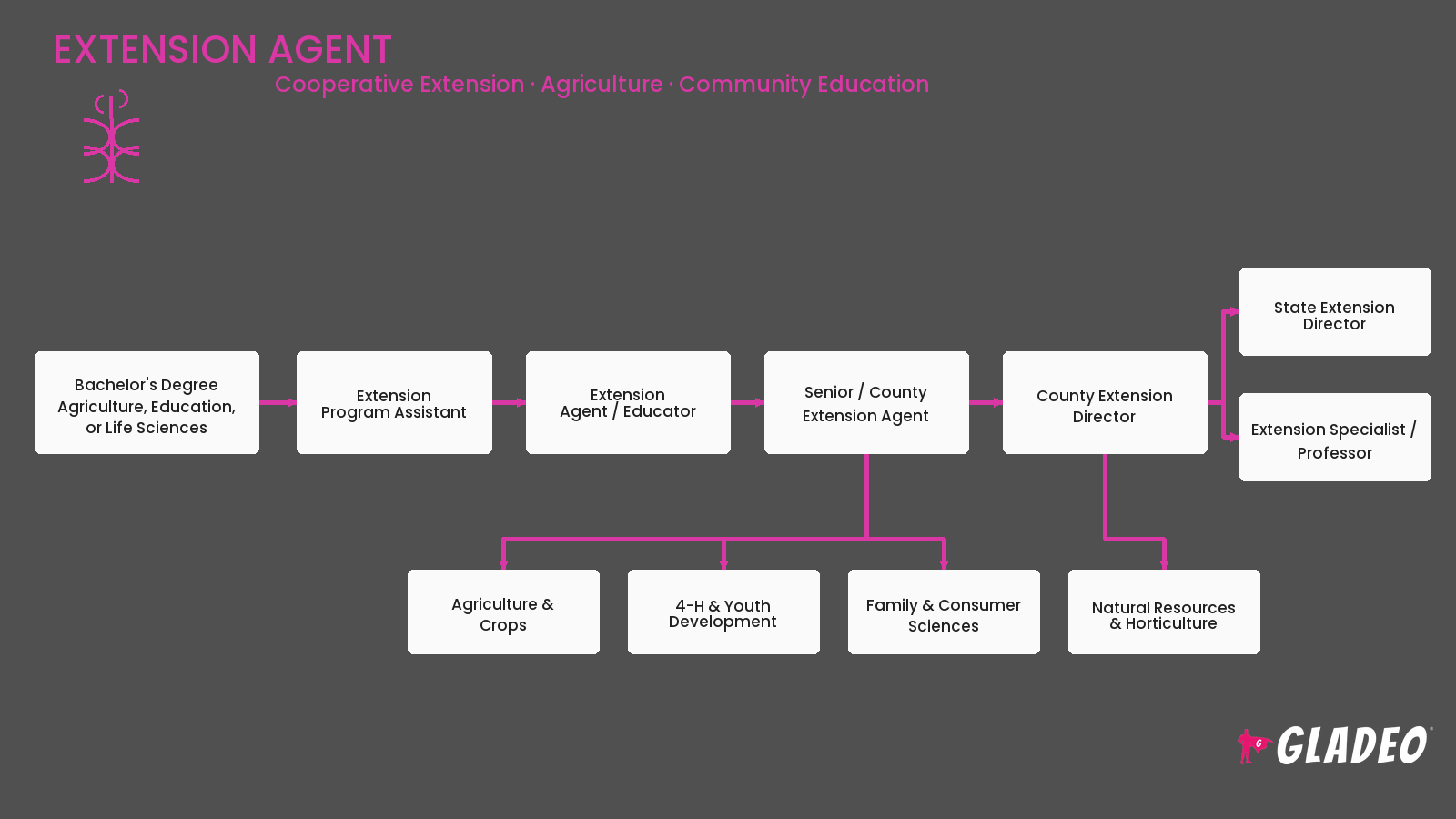
Becoming an Extension Agent typically involves earning a bachelor's degree in agriculture, horticulture, animal science, natural resource management, or a related field. Advanced degrees can open more opportunities, especially in research or specialized roles. Training focuses on both scientific knowledge and communication skills to effectively support diverse audiences.
Students can take courses in relevant subjects such as:
- Agricultural Science
- Soil Science
- Animal Science
- Plant Pathology
- Entomology
- Sustainable Agriculture
- Communication and Public Speaking
- Community Development
- Environmental Science
- Program Planning and Evaluation
Hands-on experience through internships, cooperative extension programs, or volunteering with agricultural organizations is essential. Building a portfolio of outreach projects and demonstrating strong interpersonal skills will help candidates stand out. On-the-job training often continues as agents learn to tailor programs to local needs and emerging challenges.
- Take science courses like biology, chemistry, and environmental science to build a strong foundation.
- Join agriculture-related clubs such as FFA, 4-H, or gardening clubs to gain practical experience.
- Volunteer in community service projects or youth education programs.
- Develop communication skills through debate, drama, or writing classes.
- Seek internships or summer jobs with local farms, agricultural businesses, or extension offices.
- Attend workshops or fairs focused on agriculture and natural resources.
- Learn basic computer and data analysis skills.
- Explore leadership roles in school or community organizations.
- Research colleges with strong agricultural or environmental science programs.
- Connect with professionals in agriculture to learn about career options.
- Look for programs with strong ties to cooperative extension services or land-grant universities.
- Choose courses that combine science with communication and community engagement.
- Seek opportunities for hands-on learning through labs, internships, or fieldwork.
- Consider programs offering training in digital tools and data analysis relevant to agriculture.
- Evaluate faculty expertise and research opportunities related to agriculture and natural resources.
- Check for programs that support leadership development and public speaking skills.
- Look for internships or work-study options within agricultural agencies or nonprofits.
- Ensure access to career counseling and networking events in agricultural fields.
- Consider certificate programs or workshops in grant writing and program management.
- Prioritize schools with active student organizations in agriculture or environmental advocacy.
- Confirm availability of resources for developing educational materials and outreach campaigns.
- Seek out programs with a focus on sustainability and emerging agricultural technologies.
- Volunteer at local cooperative extension offices or agricultural nonprofits to gain experience.
- Assist with community workshops or school garden projects to build outreach skills.
- Work as a farmhand or intern on agricultural operations to understand practical challenges.
- Help collect data for agricultural research studies or surveys.
- Create educational materials or social media content for local agricultural groups.
- Support event planning for farmer meetings or youth programs.
- Shadow experienced Extension Agents to learn about day-to-day work.
- Attend agricultural fairs and network with professionals and community members.
- Develop basic public speaking skills by leading small group presentations.
- Apply for entry-level positions such as Agricultural Technician or Outreach Assistant.
- Seek mentorship from university extension specialists or experienced agents.
- Participate in training sessions on communication and agricultural science updates.
- Gain expertise in specialized agricultural areas and pursue certifications.
- Develop leadership skills by managing projects or mentoring new agents.
- Build strong networks with farmers, researchers, and policymakers.
- Pursue advanced degrees to qualify for research or administrative roles.
- Stay current with emerging technologies and sustainable practices.
- Seek roles with increasing responsibility in program development and management.
- Engage in professional organizations to broaden knowledge and connections.
- Transition to roles in policy advising, consulting, or higher education teaching.
Websites:
- USDA National Institute of Food and Agriculture (NIFA) – Extension
- Extension.org
- USDA National Institute of Food and Agriculture (NIFA)
- 4-H
- National FFA Organization
- Successful Farming
- USDA Natural Resources Conservation Service (NRCS)
- USDA National Institute of Food and Agriculture – Cooperative Extension System
- Alabama Cooperative Extension System (ACES)
- Iowa State University Extension and Outreach
- North Dakota State University Agriculture and Extension (NDSU Agriculture)
- National Agricultural Law Center
- USDA National Institute of Food and Agriculture – Extension Publications
- American Society of Agronomy (ASA)
Books:
- Extension Education for Sustainable Development by S. K. Singh
- The Cooperative Extension System: An Annotated Bibliography by Bill D. Copeland
- Agricultural Extension: A Reference Manual by R. M. Sankaran
- Communicating Science Effectively: A Research Agenda by National Academies of Sciences, Engineering, and Medicine
- Sustainable Agriculture and Food Security by B. K. Singh
If working as an Extension Agent isn’t the right fit, there are many related careers that also combine agriculture, education, and community service.
- Agricultural Scientist
- Farm Manager
- Environmental Educator
- Agricultural Consultant
- Natural Resource Manager
- Community Outreach Coordinator
- Rural Development Specialist
- Agricultural Policy Analyst
- Food Safety Specialist
- Horticulturist
Newsfeed

Featured Jobs
Online Courses and Tools