






Spotlights
Forest Supervisor, Timber Manager, Wildlife Manager, Conservation Manager, Forestry Technician, Forest Conservationist, Forest Resource Manager, Silviculturist, Forest Operations Manager, Environmental Forester, Forest Ecologist, Land Manager
Every time you walk through a healthy forest, breathe fresh air, or see wildlife thriving, a Forest Manager has played a crucial role in making that possible. They balance nature’s needs with human demands, ensuring forests stay vibrant and productive for generations.
Forest Managers oversee the care, use, and protection of forest lands. Their daily work involves planning timber harvests, monitoring wildlife habitats, coordinating with environmental scientists, and enforcing regulations. They collaborate with loggers, government officials, conservation groups, and community members to manage forests sustainably and support economic activities like timber production and recreation.
Using mapping software, data analysis tools, and hands-on fieldwork, Forest Managers assess forest conditions and develop management plans. Their expertise guides decisions that protect ecosystems, support biodiversity, and provide resources responsibly, making their role vital to environmental health and community well-being.
- Contributing directly to the preservation and sustainability of forests and natural habitats.
- Seeing the positive impact of balanced forest use on wildlife, communities, and economies.
- Working outdoors in natural settings and engaging with diverse teams of experts and stakeholders.
- Playing a key role in combating climate change through sustainable forest management practices.
Working Schedule
Forest Managers often work full-time, blending office planning with extensive fieldwork in all seasons. Their schedules can be flexible but may demand long hours during critical periods such as planting seasons, wildfire prevention efforts, or timber harvests. Depending on the employer, they might work for government agencies, private companies, or nonprofits, sometimes traveling to remote forest sites and balancing multiple projects and deadlines.
Typical Duties
- Develop and update forest management plans to balance ecological, recreational, and commercial needs.
- Conduct field surveys to assess tree health, wildlife populations, and environmental impacts.
- Coordinate timber harvesting operations ensuring compliance with environmental regulations.
- Monitor forest regeneration and oversee planting and thinning activities.
- Implement wildfire prevention strategies and inspect for potential fire hazards.
- Collaborate with scientists, local communities, and government officials on conservation efforts.
- Manage budgets, contracts, and resources related to forest operations.
- Prepare reports and documentation for regulatory compliance and funding purposes.
- Educate the public and stakeholders about forest conservation and sustainable practices.
- Respond to emergencies such as pest infestations or natural disasters affecting forest health.
- Use GIS and remote sensing tools to map forest resources and analyze changes over time.
- Supervise forestry technicians and field crews during operations and research projects.
Additional Responsibilities
- Ensure safety protocols are followed during forest operations and field activities.
- Advocate for policies that support sustainable forestry and environmental protection.
- Participate in community outreach programs to raise awareness about forest stewardship.
- Evaluate the economic viability of forest products and services.
- Apply for and manage grants or funding related to conservation and resource management.
- Stay updated on new forestry research, laws, and technologies.
- Maintain partnerships with universities, nonprofits, and industry groups.
- Conduct training sessions for staff on best forestry practices and safety.
The day often starts by reviewing data from field teams and planning daily tasks. Forest Managers check weather conditions and coordinate with staff about safety and priorities. They might spend the morning in the office preparing reports or updating management plans based on recent surveys.
Midday usually involves heading out to forest sites to inspect timber stands, assess wildlife habitats, or oversee planting efforts. They interact with field crews, troubleshoot issues like pest outbreaks, and collect samples or measurements. Collaboration with contractors or community representatives may happen on site.
Afternoons are often dedicated to meetings with environmental agencies, landowners, or local officials to discuss regulations, permits, or partnerships. As deadlines approach, they finalize reports and update databases. The day might end with planning for upcoming projects or emergency response readiness.
Soft Skills
- Problem-solving and critical thinking
- Effective communication with diverse groups
- Leadership and team management
- Adaptability to changing environmental conditions
- Attention to detail in field observations and data analysis
- Time management and multitasking
- Negotiation and conflict resolution
- Decision-making under pressure
- Environmental awareness and ethical judgment
- Collaboration and networking
- Public speaking and education
- Patience and perseverance
Technical Skills
- GIS mapping and spatial analysis
- Use of forest inventory software
- Data collection and statistical analysis
- Knowledge of forestry and ecology principles
- Remote sensing technology
- Timber cruising and measurement techniques
- Fire prevention and safety protocols
- Equipment operation for fieldwork
- Report writing and documentation
- Regulatory compliance understanding
- Urban Forest Manager: Focuses on managing trees and green spaces in urban and suburban areas for community benefit.
- Wildlife Forest Manager: Specializes in maintaining habitats to support wildlife populations within forest ecosystems.
- Conservation Forest Manager: Prioritizes protecting sensitive environments and endangered species within forest lands.
- Timber Forest Manager: Concentrates on sustainable timber production and harvesting operations.
- Fire Prevention Specialist: Focuses on reducing wildfire risks through inspections and preventative measures.
- Research Forest Manager: Works primarily in scientific studies related to forest health and ecology.
- Recreation Forest Manager: Manages forests for public enjoyment, including trails, camping, and educational programs.
- Government Forest Manager: Employed by public agencies to enforce policies and manage public forest lands.
- Federal and state forestry departments
- National parks and forest services
- Private timber and land management companies
- Environmental nonprofits and conservation groups
- University research centers
- Municipal parks and recreation departments
- Wildlife management agencies
- Consulting firms specializing in natural resources
- Forest fire prevention and emergency services
- Eco-tourism and outdoor recreation organizations
- Agricultural cooperatives
- Timber industry associations
Forest Managers often face high pressure to balance environmental protection with economic interests. Decision-making can involve managing conflicts between stakeholders like loggers, conservationists, and local communities, requiring diplomacy and strong negotiation skills.
Work hours sometimes extend beyond the typical 9-to-5 schedule, especially during field seasons, wildfire threats, or when managing urgent environmental issues. Fieldwork can be physically demanding and take place in remote, rugged terrain under various weather conditions.
The role demands continuous learning to stay current with evolving forestry science, environmental laws, and technologies. Sacrifices may include time away from home during extended field visits and handling unexpected emergencies that disrupt planned work.
- Increasing use of drone technology for forest monitoring and data collection.
- Advances in GIS and remote sensing improving accuracy of forest inventories.
- Growing focus on climate change impacts and carbon sequestration in forest management.
- Integration of artificial intelligence for predicting pest outbreaks and forest health.
- Emphasis on sustainable and certified forestry practices to meet environmental standards.
- Expansion of urban forestry programs to improve city environments.
- Collaborations between public agencies and private landowners for landscape-scale conservation.
- Development of mobile apps for real-time data entry in the field.
- Increased public engagement and education about the value of forests.
- Use of bioengineering techniques to restore degraded forest areas.
Many Forest Managers developed a passion for nature by spending time outdoors, exploring woods, hiking, or camping during their childhood. They often enjoyed activities like bird watching, fishing, or participating in environmental clubs and community cleanups.
Early interests in science, especially biology and environmental studies, as well as hands-on experiences like planting trees or volunteering at nature centers, often pointed them toward a career in forestry. They may have also enjoyed map reading, outdoor survival skills, and learning about ecosystems.
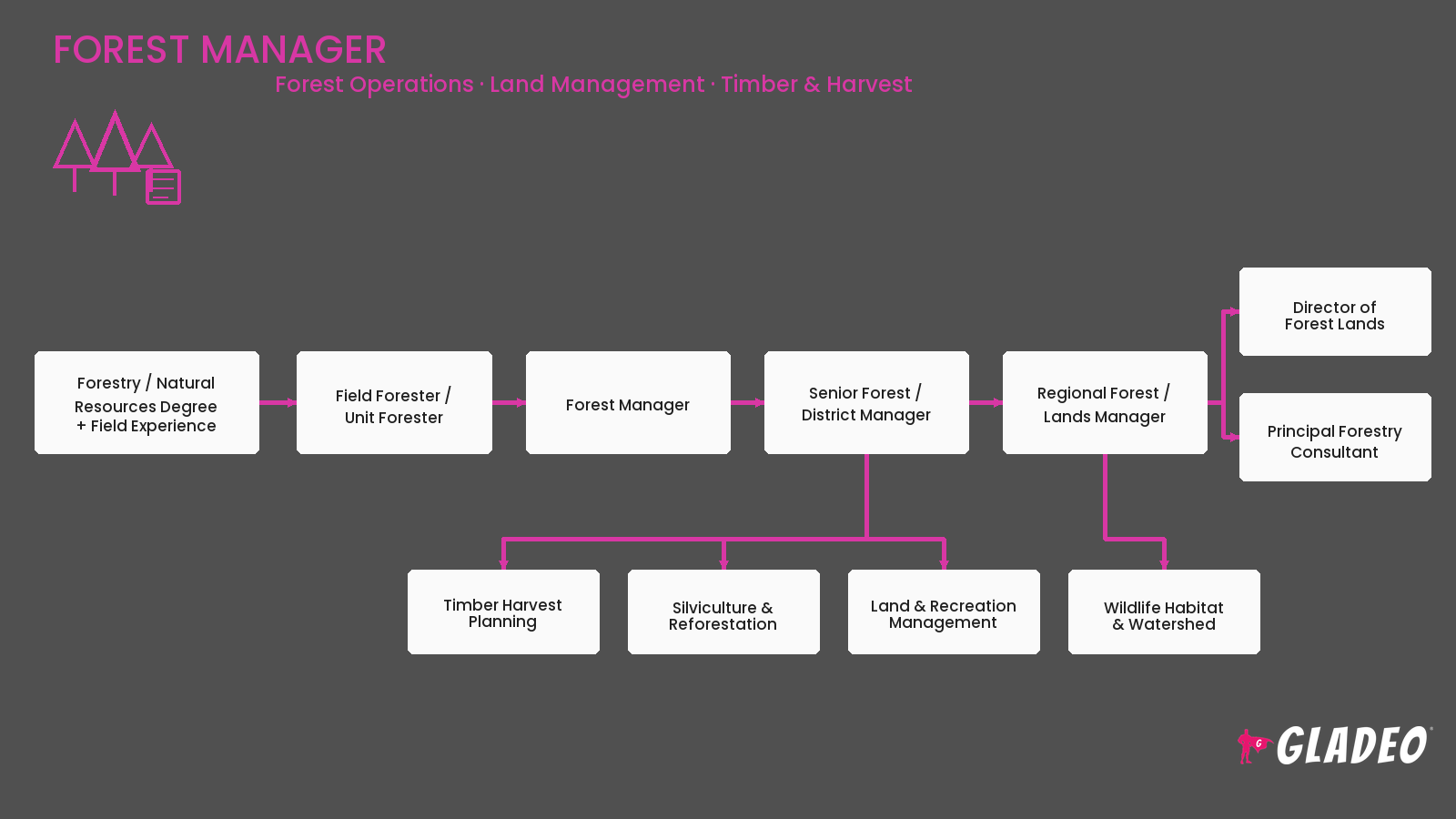
Becoming a Forest Manager typically involves earning a bachelor's degree in forestry, natural resource management, environmental science, or a related field. Specialized training in forest ecology, wildlife management, and environmental laws is essential. Many also pursue certifications or advanced degrees to deepen expertise and improve career prospects.
Students can take courses in relevant subjects such as:
- Forestry Principles and Practices
- Forest Ecology and Biology
- Wildlife Management
- Environmental Policy and Law
- Soil Science and Hydrology
- GIS and Remote Sensing
- Fire Ecology and Management
- Forest Resource Economics
- Silviculture and Timber Management
- Conservation Biology
Hands-on experience through internships, fieldwork, and cooperative education programs is critical for developing practical skills. Building a strong portfolio of project work and gaining familiarity with forestry tools and software prepare students for the workforce. Continuous learning and professional development remain important throughout a Forest Manager’s career.
- Join environmental or forestry clubs to gain early exposure.
- Take advanced science courses, especially biology, chemistry, and earth sciences.
- Enroll in computer classes focusing on GIS and data analysis.
- Participate in outdoor education programs and summer camps related to forestry.
- Volunteer with local conservation groups or park services.
- Seek internships or summer jobs in forestry or natural resource fields.
- Attend college fairs and talk to forestry professionals.
- Develop computer skills and familiarity with mapping software.
- Practice communication skills through presentations and writing assignments.
- Consider dual enrollment or community college courses in environmental science.
- Explore leadership opportunities in school clubs or community programs.
- Research colleges with strong forestry or environmental science programs.
- Look for programs accredited by professional forestry organizations.
- Ensure the curriculum covers both ecological and economic aspects of forestry.
- Choose schools offering hands-on fieldwork and lab experiences.
- Verify availability of internships or cooperative education placements.
- Check for courses in emerging technologies like GIS and remote sensing.
- Consider programs that foster strong connections with industry and government agencies.
- Look for opportunities to participate in research projects or environmental initiatives.
- Evaluate faculty expertise and their industry connections.
- Seek programs offering certifications or preparation for licensing exams.
- Check for student support services like career counseling and networking events.
- Explore options for studying abroad or in diverse ecosystems.
- Ensure access to modern laboratory and field equipment.
- Apply for internships with forestry agencies or environmental nonprofits.
- Volunteer for community tree planting or conservation projects to build experience.
- Develop a portfolio showcasing fieldwork, data collection, and project involvement.
- Build relationships with forestry professionals through networking events or social media.
- Learn to use GIS and forest inventory software through online tutorials or courses.
- Seek entry-level positions such as Forestry Technician or Assistant Forest Manager.
- Prepare for interviews by researching employer priorities and forest management challenges.
- Attend industry conferences or workshops to connect with potential employers.
- Join professional organizations to access job boards and mentorship.
- Create a strong resume highlighting relevant coursework and outdoor skills.
- Practice clear communication to explain your passion and knowledge.
- Be willing to work in remote or physically demanding environments.
- Gain advanced certifications or specialized training in forest management or fire prevention.
- Build leadership skills by managing projects and supervising crews.
- Develop expertise in emerging technologies like drones and AI applications.
- Expand professional network by joining forestry associations and attending conferences.
- Pursue advanced degrees such as a master's in forestry or environmental management.
- Seek opportunities to lead complex conservation or commercial forestry initiatives.
- Stay informed about changing environmental regulations and market demands.
- Mentor junior staff and contribute to workforce development programs.
Websites:
- Society of American Foresters (www.eforester.org)
- International Society of Arboriculture (www.isa-arbor.com)
- Forest Stewardship Council (www.fsc.org)
- American Forest Foundation (www.forestfoundation.org)
- National Wildfire Coordinating Group (www.nwcg.gov)
- US Forest Service (www.fs.usda.gov)
- The Nature Conservancy (www.nature.org)
- Association of Consulting Foresters (www.acf-foresters.org)
- Tree Care Industry Association (www.tcia.org)
- Conservation International (www.conservation.org)
- Forest Products Association of Canada (www.fpac.ca)
- Environmental Protection Agency - Forestry (www.epa.gov/forestry)
- Urban Forestry Network (www.urbanforestrynetwork.org)
- International Forestry Students' Association (www.ifsa.net)
Books:
- Forest Management by Lawrence S. Davis
- Introduction to Forest Ecosystem Science and Management by Raymond A. Young
- Forest Measurements by Thomas Eugene Avery and Harold E. Burkhart
- The Practice of Silviculture by Mark S. Ashton and Matthew J. Kelty
- Wildland Fire Management Handbook by Stephen J. Pyne
If you find that Forest Management isn’t the perfect fit, many related careers allow you to work with nature, conservation, or resource management in different ways.
- Environmental Scientist
- Wildlife Biologist
- Park Ranger
- Conservation Officer
- Agricultural Manager
- Land Surveyor
- Natural Resource Consultant
- Environmental Educator
- Firefighter (Wildland)
- GIS Specialist
Newsfeed

Featured Jobs
Online Courses and Tools