






Spotlights
HVAC Manager, HVAC Supervisor, Heating and Cooling Manager, HVAC Operations Manager, HVAC Service Coordinator, HVAC Maintenance Manager, HVAC Project Manager, HVAC Field Manager, HVAC Service Director, HVAC Team Lead, Heating Ventilation Air Conditioning Manager, HVAC Technical Manager
Imagine stepping into a building where the air feels just right — neither too hot nor too cold, with perfect ventilation that keeps everyone comfortable and healthy. HVAC Service Managers make this everyday comfort possible by overseeing the systems that control heating, ventilation, and air conditioning in homes, businesses, and industrial spaces.
Every day, HVAC Service Managers coordinate teams of technicians and service specialists to install, maintain, and repair HVAC systems. They work closely with customers to understand their needs, dispatch crews efficiently, and ensure that every job meets quality and safety standards. From planning service schedules to managing budgets and troubleshooting complex mechanical issues, their work keeps environments comfortable and safe.
Using specialized software to track work orders and manage resources, HVAC Service Managers rely on their deep knowledge of heating and cooling technologies, building codes, and energy efficiency practices. Their leadership ensures systems run smoothly, saving energy and preventing costly breakdowns — all while delivering comfort to countless people.
- Leading a skilled team that solves complex technical challenges daily.
- Seeing tangible results in improved comfort and air quality for customers.
- Building strong relationships with clients and vendors based on trust and reliability.
- Making a direct impact on energy efficiency and sustainability in buildings.
Working Schedule
HVAC Service Managers typically work full-time, often during regular business hours, but must be prepared for occasional emergency calls or after-hours issues that require immediate attention. The role can be fast-paced and deadline-driven, especially during extreme weather seasons when heating or cooling demands spike. Many work in office settings but also visit job sites regularly to oversee operations and support their teams.
Typical Duties
- Schedule and dispatch HVAC technicians to service calls and installation projects.
- Coordinate preventive maintenance programs to extend equipment life and reliability.
- Manage inventory of HVAC parts and equipment to ensure availability for repairs.
- Train and supervise service staff on safety procedures, technical skills, and customer service.
- Inspect completed work to verify quality and compliance with codes and standards.
- Develop and manage budgets for labor, materials, and equipment expenses.
- Communicate with customers to assess satisfaction and advise on system improvements.
- Analyze service data to identify trends and improve operational efficiency.
- Ensure all HVAC work complies with local building codes and safety regulations.
- Prepare reports on service activities, costs, and workforce performance.
- Collaborate with sales teams to support new installation contracts.
- Troubleshoot complex HVAC problems and provide technical guidance to technicians.
Additional Responsibilities
- Maintain certifications and stay updated on HVAC technology advancements.
- Negotiate service contracts and vendor agreements.
- Implement energy-saving initiatives and recommend system upgrades.
- Handle customer complaints and resolve service issues professionally.
- Coordinate with other building maintenance teams for integrated facility management.
- Monitor compliance with occupational health and safety regulations.
- Plan staffing needs and recruit qualified technicians.
- Lead emergency response efforts during HVAC system failures.
The day often starts with reviewing the schedule and assigning service calls based on urgency and technician availability. The manager checks overnight reports for any emergency issues that need immediate attention. They might meet with senior staff to discuss upcoming projects or budget updates.
Midday involves coordinating with technicians in the field via phone or mobile apps, troubleshooting problems remotely, and ordering necessary parts. The manager also communicates with customers to provide updates and schedule follow-ups. Paperwork like work orders and compliance documentation gets processed during quieter moments.
In the afternoon or evening, the HVAC Service Manager visits job sites to inspect ongoing work, provide technical support, or conduct safety audits. They wrap up by updating service logs, planning for the next day, and addressing any urgent staffing or equipment concerns.
Soft Skills
- Leadership and team management
- Clear communication
- Problem-solving under pressure
- Customer service orientation
- Time management
- Conflict resolution
- Adaptability and flexibility
- Attention to detail
- Organizational skills
- Decision-making
- Stress management
- Collaboration and teamwork
Technical Skills
- Knowledge of HVAC systems and components
- Familiarity with HVAC service and diagnostic tools
- Understanding of building codes and safety standards
- Scheduling and dispatch software proficiency
- Budgeting and resource management
- Technical troubleshooting
- Inventory management
- Use of mobile communication devices
- Energy efficiency principles
- Data analysis and reporting
- Residential HVAC Service Manager: Focuses on heating and cooling systems in homes and small buildings.
- Commercial HVAC Service Manager: Manages HVAC operations in office buildings, retail stores, and warehouses.
- Industrial HVAC Service Manager: Oversees large-scale HVAC systems in factories and manufacturing plants.
- Energy Efficiency Manager: Specializes in optimizing HVAC systems to reduce energy consumption.
- Maintenance Manager: Concentrates on preventive maintenance and repair scheduling.
- Project Manager: Handles installation projects and system upgrades from start to finish.
- Field Service Manager: Leads technicians working on-site at various locations.
- Service Operations Manager: Focuses on workflow optimization and customer service excellence.
- HVAC service companies
- Building maintenance firms
- Construction contractors
- Property management companies
- Manufacturing plants
- Energy utility companies
- Government facilities
- Hospitality industry (hotels, resorts)
- Healthcare facilities
- Educational institutions
- Retail chains
- Commercial real estate firms
HVAC Service Managers often face tight deadlines and high-pressure situations, especially during extreme weather when demand for heating or cooling spikes. They must balance urgent customer needs with efficient resource allocation, which requires calm decision-making and prioritization.
Work hours are typically full-time during weekdays, but the role may require availability for emergency calls or weekend coverage. This can lead to unpredictable schedules and occasional overtime during peak seasons or major system failures.
The job demands both mental and physical stamina. Managers need to navigate complex technical problems, manage diverse teams, and handle customer expectations. They must be comfortable with frequent multitasking, continual learning, and adapting to evolving HVAC technologies and regulations.
- Growing emphasis on energy-efficient HVAC systems and green technologies.
- Increased use of smart thermostats and IoT-connected HVAC components.
- Rising demand for HVAC systems that improve indoor air quality.
- Integration of predictive maintenance using data analytics.
- More focus on sustainable refrigerants with lower environmental impact.
- Use of mobile apps for scheduling, diagnostics, and communication.
- Development of advanced HVAC training programs using virtual reality.
- Expansion of HVAC services into renewable energy systems like geothermal.
- Growing regulatory requirements for safety and environmental standards.
- Adoption of automated inventory and parts management systems.
Many HVAC Service Managers enjoyed tinkering with mechanical or electrical devices as kids, often curious about how heating and cooling systems worked in their own homes or school buildings. They liked solving puzzles and fixing things, which laid the groundwork for their technical skills.
They also tended to thrive in leadership roles early on, organizing group projects or helping friends and family with repairs. Their interest in both technology and people made them natural fits for managing teams and complex service operations.
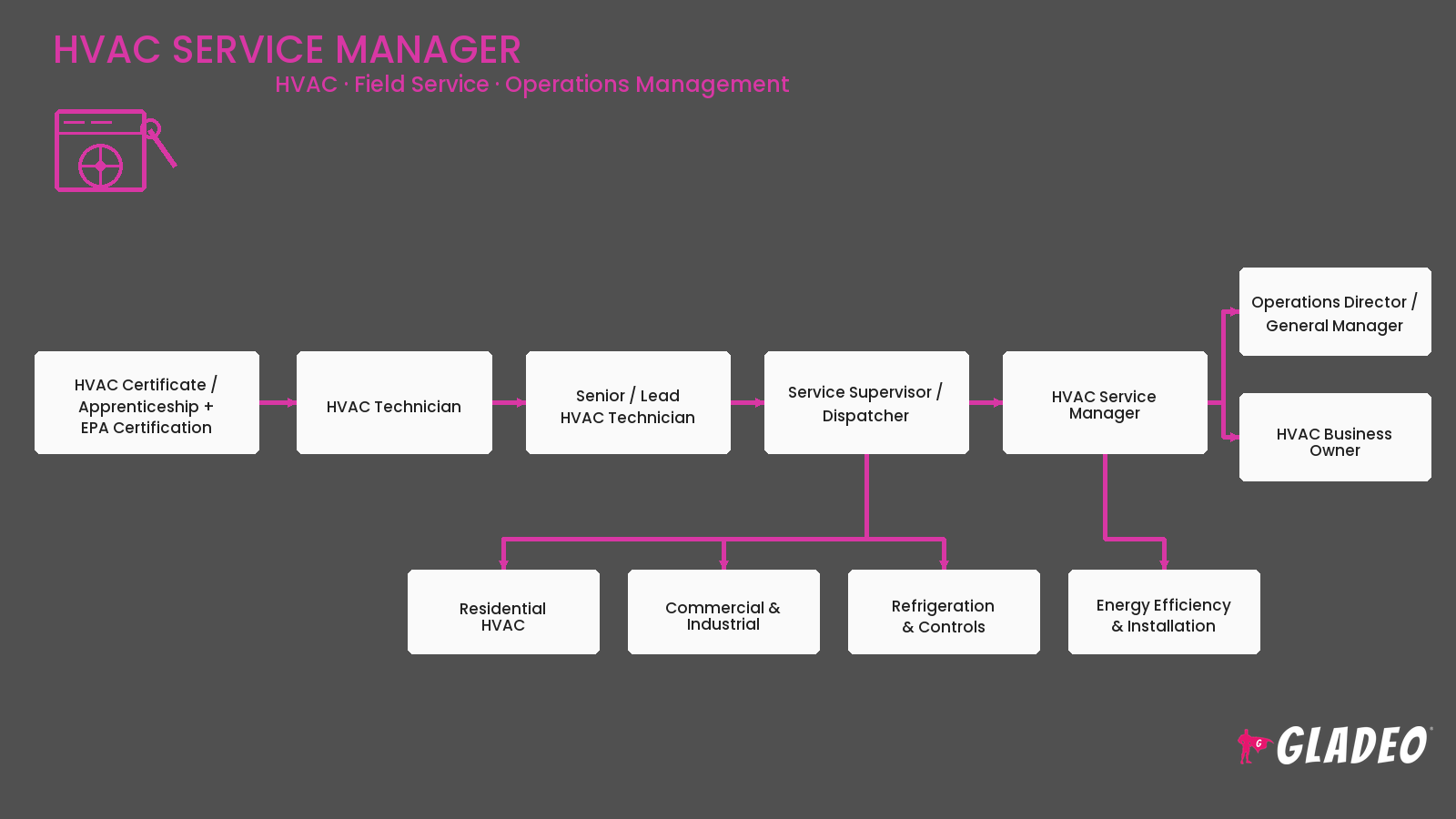
Becoming an HVAC Service Manager usually starts with gaining solid technical knowledge and hands-on experience in heating, ventilation, and air conditioning systems. Many professionals begin as HVAC technicians before moving into management roles. Formal education can include vocational training, associate degrees, or bachelor's degrees focused on HVAC technology, building systems, or facility management.
Students can take courses in relevant subjects such as:
- HVAC Fundamentals
- Electrical Systems for HVAC
- Heating and Cooling Systems
- Blueprint Reading and Technical Drawing
- Building Codes and Safety Regulations
- Energy Management and Sustainability
- Project Management
- Business and Leadership Skills
- Customer Service and Communication
- Computer-Aided Design (CAD)
Hands-on experience through apprenticeships or technician roles is critical to develop problem-solving skills and technical expertise. Aspiring managers benefit greatly from internships or cooperative education programs to build a strong portfolio. On-the-job training and professional certifications further enhance career growth and credibility in this field.
- Take classes in math, physics, and shop technology to build a strong technical foundation.
- Join technology or engineering clubs to develop problem-solving and teamwork skills.
- Pursue vocational training programs or certifications in HVAC during high school if available.
- Explore internships or summer jobs with HVAC companies to gain practical experience.
- Develop computer skills, especially with scheduling and diagnostic software.
- Focus on communication and leadership activities like student government or group projects.
- Attend college courses in HVAC technology, mechanical engineering, or facilities management.
- Seek out mentorship from professionals in the HVAC industry.
- Build a portfolio of projects or repairs to showcase skills.
- Stay current on new technologies and energy efficiency trends through workshops and seminars.
- Look for programs accredited by recognized HVAC or trade organizations.
- Choose schools offering hands-on labs and real-world training opportunities.
- Verify faculty experience in the HVAC industry and management roles.
- Check for strong partnerships with local employers for internships and job placement.
- Ensure curriculum covers both technical HVAC skills and business management.
- Consider programs that teach use of industry-standard software and diagnostic tools.
- Find schools that prepare students for professional certifications.
- Evaluate class sizes and student support services for personalized learning.
- Confirm availability of resources like tool libraries and simulation labs.
- Seek programs with up-to-date facilities and equipment reflecting current industry standards.
- Prioritize schools with a focus on energy efficiency and sustainability.
- Look for continuing education opportunities and workshops post-graduation.
- Apply for entry-level HVAC technician positions to gain hands-on experience.
- Volunteer for maintenance tasks or assist senior technicians to learn on the job.
- Practice using diagnostic tools and software to build technical proficiency.
- Develop strong communication skills by interacting with customers and team members.
- Take responsibility for learning safety protocols and building codes.
- Seek feedback and learn from experienced HVAC professionals.
- Document your work and technical challenges to build a professional portfolio.
- Pursue relevant certifications such as EPA 608 or NATE credentials.
- Network with industry professionals through trade shows or local associations.
- Demonstrate reliability and a strong work ethic to earn trust and advancement.
- Shadow HVAC Service Managers to understand management responsibilities.
- Take additional courses in leadership and business management when possible.
- Gain certifications in advanced HVAC technologies and management.
- Develop leadership skills through formal training and mentorship.
- Build a reputation for reliability and problem-solving among clients and colleagues.
- Expand knowledge of energy-efficient systems and sustainability practices.
- Take on increasingly complex projects and larger teams.
- Network actively within professional HVAC and facilities management organizations.
- Stay updated on industry regulations and safety standards.
- Pursue advanced education such as a bachelor’s degree in facility or construction management.
Websites:
- Air Conditioning Contractors of America (ACCA) - acca.org
- Refrigeration Service Engineers Society (RSES) - rses.org
- HVAC Excellence - hvacexcellence.org
- National Association of Home Builders (NAHB) - nahb.org
- Mechanical Contractors Association of America (MCAA) - mcaa.org
- Building Performance Institute (BPI) - bpi.org
- ASHRAE (American Society of Heating, Refrigerating and Air-Conditioning Engineers) - ashrae.org
- Energy Star - energystar.gov
- International Facility Management Association (IFMA) - ifma.org
- National Institute for Certification in Engineering Technologies (NICET) - nicet.org
- Occupational Safety and Health Administration (OSHA) - osha.gov
- Manufacturers’ websites like Trane, Carrier, Lennox for technical resources
- Trade publications such as ACHR News - achrnews.com
- LinkedIn HVAC professional groups
Books:
- HVAC Fundamentals by Samuel Sugarman
- Modern Refrigeration and Air Conditioning by Althouse, Turnquist, Bracciano
- HVAC Management Guide by Mike Murphy
- The HVAC Technician’s Handbook by Billy C. Langley
- Residential Construction Academy: HVAC by Eugene Silberstein
If the path to becoming an HVAC Service Manager doesn’t feel like the perfect fit, your skills and interests can lead you to several related careers that still involve technical knowledge, problem-solving, and leadership.
- HVAC Technician
- Building Maintenance Supervisor
- Energy Auditor
- Facilities Manager
- Mechanical Engineer
- Construction Project Manager
- Plumbing Supervisor
- Electrical Systems Manager
- Environmental Health and Safety Specialist
- Technical Sales Representative for HVAC equipment
Newsfeed

Featured Jobs
Online Courses and Tools