





Spotlights
Water Resource Scientist, Hydrogeologist, Environmental Hydrologist, Surface Water Hydrologist, Groundwater Hydrologist, Water Quality Specialist, Watershed Scientist, Hydrologic Technician, Climate Hydrologist, Flood Risk Analyst, Stormwater Engineer, Aquatic Scientist
Every time a community safely drinks clean water, avoids flood damage, or manages drought wisely, hydrologists have played a key role behind the scenes. Their work shapes how societies use and protect one of Earth's most vital resources: water.
Hydrologists study the movement, distribution, and quality of water on Earth. Their days are filled with collecting field data from rivers, lakes, and underground aquifers, running computer models, and analyzing how water interacts with the environment. They collaborate closely with environmental scientists, engineers, urban planners, and government agencies to provide insights that guide water management policies and infrastructure projects.
Using advanced tools like geographic information systems (GIS), remote sensing, and hydrologic simulation software, hydrologists translate complex data into clear, actionable knowledge. Their work is crucial for preventing water-related disasters, ensuring sustainable water supply, and protecting ecosystems for future generations.
- Knowing your research helps protect communities from floods and droughts
- Contributing to the conservation of natural water resources and ecosystems
- Solving real-world environmental challenges with scientific methods
- Working outdoors in diverse landscapes combined with high-tech data analysis
Working Schedule
Hydrologists typically work full-time, often balancing time between office analysis and fieldwork in various weather conditions. Deadlines can be tight when responding to emergencies like floods or contamination events, but many enjoy a flexible schedule when conducting long-term research projects. While some are employed by government agencies or consulting firms with regular hours, others work freelance or on contract, which can require travel and irregular hours.
Typical Duties
- Collect water samples from streams, lakes, and groundwater sources for quality testing
- Use instruments to measure water flow, rainfall, and soil moisture
- Analyze data using computer models to predict water movement and availability
- Prepare reports and maps that communicate findings to stakeholders
- Monitor the effects of land use and climate change on water systems
- Collaborate with engineers to design water management structures like dams and levees
- Advise policymakers on sustainable water use and conservation practices
- Conduct environmental impact assessments for construction and development projects
- Maintain and calibrate hydrological monitoring equipment
- Develop strategies for flood control and drought mitigation
- Present research findings at conferences and community meetings
- Train technicians and junior staff in field and lab procedures
Additional Responsibilities
- Stay updated on the latest hydrology research and technologies
- Write grant proposals to fund research projects
- Participate in interdisciplinary teams tackling environmental challenges
- Educate the public about water conservation and environmental stewardship
- Ensure compliance with environmental regulations and standards
- Mentor students and interns interested in hydrology
- Contribute to scientific publications and professional journals
- Assist in emergency response efforts related to water contamination or natural disasters
A hydrologist’s morning often begins by reviewing weather data, recent field measurements, and project goals. They may prepare equipment and coordinate with field teams to collect water samples or measure stream flows.
By midday, much of the work involves analyzing collected data using specialized software to understand water patterns and predict future conditions. Hydrologists often collaborate with engineers, environmental planners, and government officials to interpret findings and develop solutions.
In the afternoon or evening, hydrologists compile reports, update databases, and participate in meetings or community outreach. They may also spend time writing proposals for new research or attending professional workshops to stay current with advances in their field.
Soft Skills
- Critical thinking
- Problem-solving
- Attention to detail
- Effective communication
- Collaboration and teamwork
- Adaptability
- Patience and persistence
- Curiosity about the natural world
- Time management
- Public speaking
- Ethical judgment
- Leadership
Technical Skills
- Data collection and sampling techniques
- Geographic Information Systems (GIS)
- Hydrologic modeling software (e.g., HEC-HMS, SWAT)
- Remote sensing and satellite data interpretation
- Statistical analysis
- Water quality testing methods
- Field equipment operation and maintenance
- Report writing and documentation
- Environmental regulations knowledge
- Computer programming basics (e.g., Python, R)
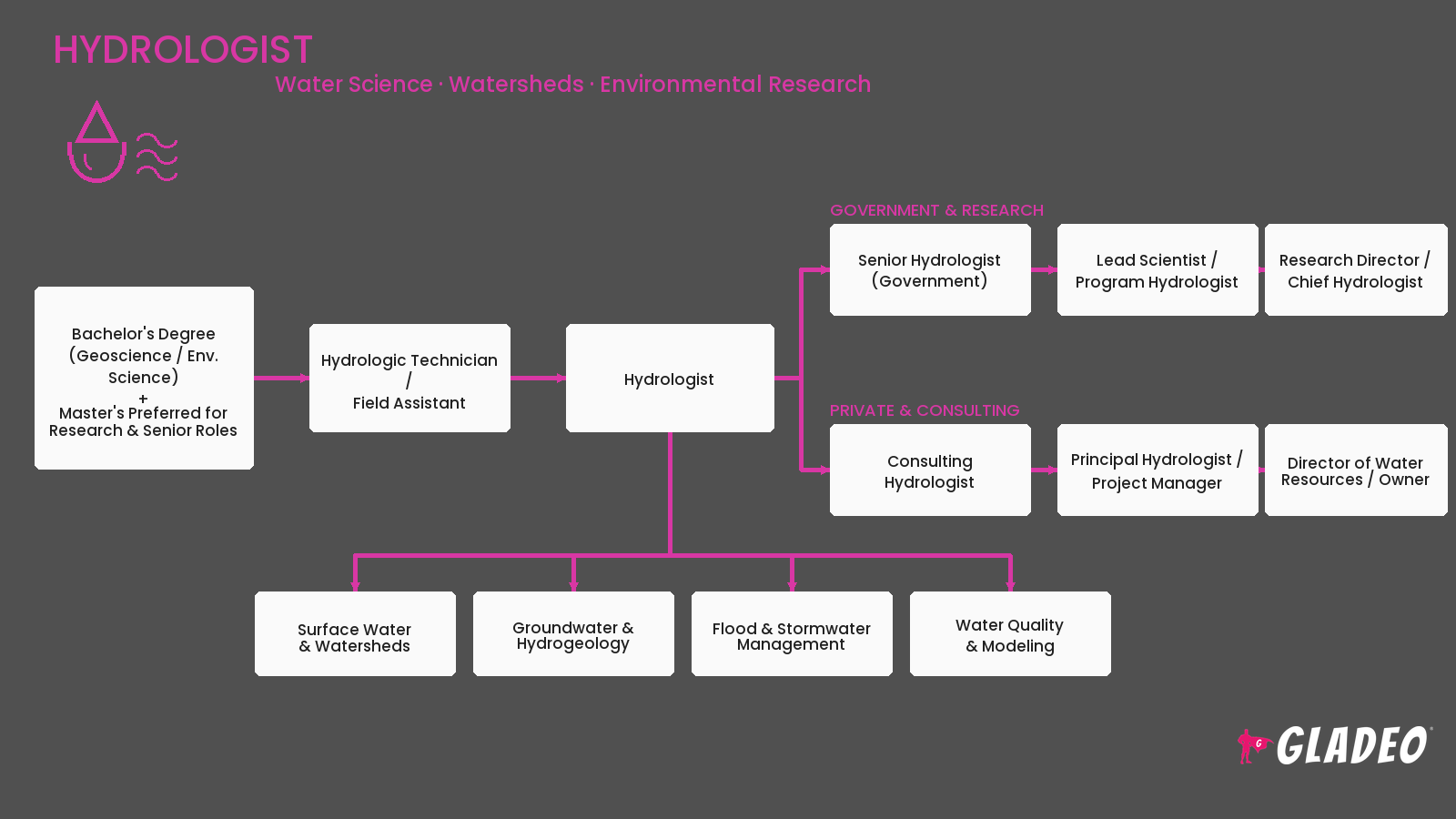
- Surface Water Hydrologist: Focuses on rivers, lakes, and streams to study surface water dynamics.
- Groundwater Hydrologist: Specializes in underground water resources and aquifer behavior.
- Environmental Hydrologist: Examines the impact of human activity on water quality and ecosystems.
- Climate Hydrologist: Studies how climate change affects water cycles and availability.
- Hydrometeorologist: Integrates meteorology and hydrology to understand precipitation patterns.
- Urban Hydrologist: Works on water management challenges in cities, such as stormwater runoff.
- Watershed Scientist: Analyzes entire drainage basins to manage water resources holistically.
- Flood Risk Analyst: Assesses flood hazards and develops strategies to reduce risk.
- Environmental protection agencies
- Water resource management districts
- Research universities
- Engineering and environmental consulting firms
- Federal and state government agencies
- Nonprofit conservation organizations
- Public health departments
- Agricultural extension services
- Hydroelectric power companies
- Urban planning departments
- Disaster management agencies
- International water resource organizations
Hydrologists often face pressure to deliver accurate and timely data that can affect public safety, especially during floods or droughts. Balancing rigorous scientific standards with real-world urgency requires focus and resilience.
Work hours can be irregular, especially during field campaigns or emergency responses. Physical demands include working outdoors in various weather conditions and sometimes in remote or challenging environments.
The job demands ongoing learning as new technologies and environmental challenges emerge. Revision cycles can be intense, with multiple rounds of data verification and peer review to ensure reliability.
- Increased use of drones and remote sensing for water data collection
- Integration of artificial intelligence and machine learning in hydrologic modeling
- Greater focus on climate change impacts on water resources
- Advances in real-time water quality monitoring sensors
- Expansion of citizen science programs for water data
- Use of big data analytics to combine diverse environmental data sets
- Development of sustainable urban water management solutions
- Growing collaboration between hydrologists and policymakers
- Emphasis on interdisciplinary approaches combining ecology, geology, and social science
- More funding directed toward water infrastructure resilience
Many hydrologists were fascinated by natural science and the outdoors from a young age, enjoying activities like hiking, fishing, or exploring rivers and lakes. They often showed curiosity about how water moves and changes the landscape.
Early interests may include science fairs focused on environmental topics, model building of water cycles, or volunteering for local conservation projects. A passion for solving puzzles and environmental stewardship often hints at a future in hydrology.
Becoming a hydrologist usually requires a degree in hydrology, environmental science, geology, civil engineering, or a related field. Many hydrologists hold a bachelor's degree, but advanced positions often require a master's or doctorate.
Students can take courses in relevant subjects such as:
- Environmental Science
- Geology and Earth Science
- Chemistry
- Physics with emphasis on fluid mechanics
- Mathematics including calculus and statistics
- Geographic Information Systems (GIS)
- Computer Science and Programming
- Hydrology and Water Resources Engineering
- Remote Sensing and Satellite Data Analysis
- Environmental Policy and Management
Hands-on experience is critical for hydrologists. Internships, research projects, and fieldwork during college help build practical skills. Developing a portfolio of research and reports can greatly aid in job searches. Entry-level positions often provide further on-the-job training to master specialized tools and techniques.
- Take advanced science courses like biology, chemistry, physics, and earth science
- Enroll in math classes up through calculus and statistics
- Join environmental clubs or science fairs to build related experience
- Explore computer programming and GIS software basics
- Volunteer for local water quality or conservation projects
- Attend summer camps or workshops focused on environmental science
- Seek internships or job shadowing opportunities in environmental agencies
- Participate in outdoor activities to understand natural water systems
- Develop strong writing and communication skills
- Research colleges with hydrology or environmental science programs
- Choose programs with strong fieldwork and lab components
- Look for courses teaching GIS and hydrologic modeling software
- Consider schools with research opportunities in water resources
- Seek internships or cooperative education programs
- Evaluate faculty expertise in hydrology and related fields
- Check for partnerships with government agencies or environmental organizations
- Ensure curriculum covers environmental policy and regulation
- Find programs that encourage interdisciplinary learning
- Look for programs offering training in data analysis and computer programming
- Verify accreditation and reputation of the school
- Apply for internships at environmental or water resource agencies
- Volunteer for local conservation or water quality projects
- Build a portfolio showcasing research, data analysis, and fieldwork
- Network with professionals through conferences and environmental groups
- Consider entry-level roles like hydrologic technician or research assistant
- Develop proficiency in GIS and hydrologic modeling software
- Seek mentors among professors or professionals in the field
- Attend workshops or certification courses to boost skills
- Prepare for interviews with knowledge of local water issues
- Stay informed about environmental regulations and current challenges
- Pursue opportunities to assist in field data collection
- Be willing to relocate for jobs in water-stressed regions
- Gain expertise in advanced hydrologic modeling and data science
- Build strong relationships with government agencies and stakeholders
- Publish research in scientific journals to build reputation
- Take leadership roles in projects and teams
- Pursue advanced degrees or certifications
- Expand knowledge in related fields like ecology or engineering
- Stay current with emerging technologies and policies
- Develop skills in grant writing and project management
Websites:
- American Geophysical Union (agu.org)
- National Ground Water Association (ngwa.org)
- Hydrogeology Division of the Geological Society of America (gsahydro.org)
- Water Environment Federation (wef.org)
- International Association of Hydrological Sciences (iahs.info)
- U.S. Geological Survey Water Resources (usgs.gov/water)
- Environmental Protection Agency Water Topics (epa.gov/water)
- Society of Wetland Scientists (wetland.org)
- American Water Resources Association (awra.org)
- Union of Concerned Scientists Water Program (ucsusa.org)
- Hydroinformatics and Water Resources Engineering (hydroinformatics.org)
- The Water Project (thewaterproject.org)
- World Water Council (worldwatercouncil.org)
- National Oceanic and Atmospheric Administration Water Resources (noaa.gov/water)
Books:
- Introduction to Hydrology by Warren Viessman Jr. and Gary L. Lewis
- Applied Hydrology by Ven Te Chow, David R. Maidment, and Larry W. Mays
- Hydrology and the Management of Watersheds by Kenneth N. Brooks, Peter F. Ffolliott, Joseph A. Magner
- Groundwater Science by Charles R. Fitts
- Environmental Hydrology by Andy D. Ward and Stanley W. Trimble
If a career as a hydrologist doesn’t fit your goals or interests, many related professions allow you to work with water, the environment, or science in impactful ways.
- Environmental Scientist
- Geologist
- Civil Engineer
- Water Quality Technician
- Meteorologist
- Ecologist
- GIS Specialist
- Environmental Consultant
- Natural Resource Manager
- Climate Scientist
Newsfeed

Featured Jobs
Online Courses and Tools