






Spotlights
Process Improvement Engineer, Manufacturing Engineer, Operations Engineer, Continuous Improvement Engineer, Lean Six Sigma Black Belt, Supply Chain Engineer, Logistics Engineer, Quality Engineer, Systems Engineer, Operations Research Analyst, Healthcare Systems Engineer, Production Planning Engineer
Have you ever wondered how a package ordered at midnight shows up on your doorstep the next day, how a theme park moves thousands of people through a ride line without everyone losing their patience, or how an emergency room gets patients seen faster? Behind each of these everyday miracles is an Industrial Engineer. They are the engineers who look at a whole system, whether it is a factory, a warehouse, a hospital, or a delivery network, and ask the question that changes everything: how could this work better? Their answers save time, money, materials, and sometimes even lives.
Industrial Engineers redesign how work gets done. They might watch how workers assemble a product, time each step with a stopwatch or sensor, and then rearrange the workstation so that every movement counts. They might build a computer simulation of a distribution center to test a new layout before a single shelf is moved, or crunch the numbers to figure out how many nurses a hospital unit needs on a busy Saturday night. They team up with production workers, managers, designers, software developers, safety specialists, and executives, and they spend as much time talking with the people doing the work as they do looking at data. The best Industrial Engineers listen first, because the people closest to a problem usually know where the waste is hiding.
Their toolkit blends math, data, and people skills. They use process mapping, time and motion studies, statistics, lean manufacturing methods, Six Sigma, optimization models, simulation software, and tools for data analysis and visualization. Their work matters because every system, from a pizza kitchen to an aircraft factory, can lose enormous amounts of time and money to hidden delays, errors, and waste. When an Industrial Engineer makes a system smoother, products get cheaper and safer, workers face less strain, customers get what they need faster, and organizations have more resources to do even better things.
- Seeing a messy, frustrating process turn into a smooth one and knowing your idea made the difference
- Working in almost any industry you can imagine, from sports and entertainment to healthcare, aerospace, retail, and food
- Combining math, technology, and people skills in a job that is never boring and rarely the same two years in a row
- Making work safer, easier, and more satisfying for the people who do it every day
Working Schedule
Most Industrial Engineers work full-time, usually around 40 hours a week. The day is often a blend of desk work, such as analyzing data, building models, and writing reports, and time on the floor of a factory, warehouse, hospital, or distribution center, observing processes and working with the team. Project deadlines, product launches, or a facility shutdown can bring longer weeks, and engineers in manufacturing sometimes support night or weekend shifts when a new line is starting up. Some Industrial Engineers travel to multiple plants, customer sites, or client companies, especially in consulting. Others stay in one location and become the go-to improvement expert for a single facility. Hybrid work is increasingly common for modeling and analysis, but the heart of the job is still being where the work happens.
Typical Duties
- Studying how work is done by observing, timing, and mapping every step of a process
- Redesigning workstations, production lines, warehouses, and facility layouts to reduce wasted movement and improve flow
- Building computer simulations and mathematical models to test changes before they are made in the real world
- Using lean and Six Sigma methods to find and eliminate waste, delays, defects, and rework
- Collecting and analyzing production, quality, and cost data to find bottlenecks and root causes
- Setting time standards and production targets, and determining how many people, machines, and materials a job needs
- Designing quality control systems and statistical process control charts to catch problems early
- Improving the flow of materials and inventory through supply chains, from suppliers to customers
- Designing safer and more comfortable workspaces using ergonomics to prevent injuries
- Evaluating new equipment, automation, and robots and building the business case for investing in them
- Creating schedules, staffing plans, and capacity forecasts to match supply with demand
- Writing standard operating procedures, training materials, and reports that explain changes to teams and managers
Additional Responsibilities
- Leading cross-functional improvement teams and running rapid improvement events such as kaizen workshops
- Presenting recommendations and cost savings to managers and executives
- Working with software teams to implement new planning, scheduling, and tracking systems
- Tracking the results of changes over time to make sure improvements stick
- Coaching supervisors and front-line workers to spot problems and suggest their own solutions
- Supporting safety audits and helping the organization meet quality and regulatory standards
- Evaluating suppliers and helping negotiate better delivery performance
- Staying current on new tools, such as data analytics, automation, and artificial intelligence, and testing how they can help
An Industrial Engineer's morning might start at a manufacturing plant with a quick team huddle, checking the dashboards to see how yesterday's production went. Maybe one assembly line fell behind schedule, or the number of defects crept up on a certain product. The engineer pulls the data, spots a pattern, and heads to the floor to see what is happening with their own eyes, often called a gemba walk. They chat with the operators, watch the process, and notice that parts are being stored far from where they are used, which means workers lose a little time with every cycle that adds up to hours a week.
Midday might be spent timing a new workstation or building a model. The engineer might use a stopwatch or a video recording to measure how long each step takes, mapping the workflow on a whiteboard with the team. Back at the computer, they plug their numbers into a simulation of the line to see how a new layout would perform. They try a version where parts are placed within arm's reach, another where two tasks are combined, and another with an extra worker, and compare the results for output, cost, and worker comfort.
In the afternoon, the engineer meets with a supervisor and a few operators to share the proposed change and ask for feedback, since people who do the job every day often spot something the model missed. They update the plan, work up a quick cost and savings estimate, and schedule a trial for next week. The rest of the day might go to a status meeting with the project team, writing a short report, and answering an email from a supply chain manager about delivery times. Before leaving, they set up the data collection for tomorrow so they can measure whether the improvement really works.
Soft Skills
- Curiosity about how things work and how they could work better
- Analytical thinking and a love of solving puzzles with many moving parts
- Communication skills for explaining technical ideas to workers and executives alike
- Listening and empathy, so the people doing the work feel respected and heard
- Leadership and the ability to guide teams without always being the boss
- Persuasion and change management, since people often resist new ways of working
- Organization and project management
- Systems thinking, seeing how one change affects the whole process
- Patience and persistence in testing, measuring, and refining
- Teamwork across engineering, operations, finance, and management
- Attention to detail balanced with the ability to see the big picture
- Creativity in finding simple solutions to expensive problems
Technical Skills
- Statistics and probability, including hypothesis testing and quality control charts
- Optimization and operations research methods, such as linear programming and scheduling models
- Lean manufacturing tools like value stream mapping, 5S, kanban, and takt time
- Six Sigma methods such as DMAIC, root cause analysis, and design of experiments
- Time and motion study, work measurement, and ergonomics
- Simulation software such as Arena, Simio, FlexSim, or AnyLogic
- Data tools such as Excel, SQL, Python, Minitab, JMP, Tableau, and Power BI
- Facilities layout, material handling, and warehouse design
- Supply chain, inventory, and production planning concepts, often using ERP systems like SAP
- CAD and drawing tools like AutoCAD for creating layouts
- Manufacturing Engineer: Designs and improves production lines, tooling, and assembly processes in factories
- Quality Engineer: Builds systems that catch defects early and make sure products meet standards
- Supply Chain and Logistics Engineer: Optimizes how materials and products move from suppliers through warehouses to customers
- Healthcare Systems Engineer: Improves patient flow, scheduling, and staffing in hospitals and clinics
- Human Factors and Ergonomics Engineer: Designs workspaces, tools, and tasks around how people actually move and think
- Operations Research Analyst: Uses advanced math and data models to solve complex scheduling, routing, and resource problems
- Process Improvement Consultant: Works with many companies to teach and apply lean and Six Sigma methods
- Simulation and Automation Engineer: Builds digital models and plans for robots and automated systems before they are installed
- Automotive, aerospace, and electronics manufacturers
- Food and beverage producers
- Pharmaceutical and medical device companies
- Hospitals, clinics, and health systems
- E-commerce, retail, and distribution companies
- Package delivery, airline, trucking, and shipping companies
- Theme parks, sports organizations, and entertainment venues
- Banks, insurance companies, and call centers
- Consulting and professional services firms
- Government agencies, the military, and public transit systems
- Construction and engineering firms
- Technology companies building logistics software and automation
Industrial Engineers are expected to deliver measurable results. Organizations want to see faster delivery, fewer defects, lower costs, or safer workplaces, and the engineer is often responsible for showing the numbers. That means building a clear case for change and following up to prove it worked. When a project does not hit its targets, engineers need to figure out why and adapt, which takes accountability and a willingness to learn from setbacks.
Change is hard, and a big part of the job is helping people through it. Workers may worry that improvements mean job cuts or extra pressure, and managers may be attached to the way things have always been done. Industrial Engineers need to earn trust by listening, involving people in solutions, and being honest about what a change will mean. They must also balance competing goals, such as speed versus quality or cost versus safety, and make recommendations that are fair to workers as well as profitable for the company.
The work can involve time on noisy factory floors, in warehouses, or at hospital units, plus travel between sites, and occasionally nights or weekends to support a launch or an urgent fix. Deadlines can be tight when a company is launching a product or opening a new facility. The reward is that Industrial Engineers see their ideas in action, and the skills they build, from data analysis to leadership, make them valuable in nearly every industry.
- Growth of e-commerce driving demand for faster, smarter warehouses and delivery networks
- Rapid adoption of robotics and automation, including collaborative robots that work alongside people
- Digital twins and advanced simulation that let companies test an entire factory in software first
- Data analytics, machine learning, and artificial intelligence used to forecast demand, schedule work, and spot problems
- Smart factories and Industry 4.0, with sensors and connected machines tracking every step of production
- Supply chain resilience, as companies rethink how to avoid shortages and disruptions
- Reshoring and nearshoring of manufacturing to bring production closer to customers
- Healthcare process improvement, including shorter wait times, better scheduling, and safer patient care
- Sustainability goals driving efforts to cut waste, energy use, and emissions in operations
- Greater focus on worker well-being, ergonomics, and safety, including wearable sensors and exoskeletons
- Low-code tools and dashboards that put data in the hands of front-line teams
Many Industrial Engineers were the kids who could not help noticing inefficiencies. They reorganized their bedrooms to get ready faster, figured out the quickest route through the grocery store, or worked out how to line up the school lunch line so it moved faster. They enjoyed strategy games, building games, and puzzles where the goal was to make a system run like clockwork, from Factorio, Minecraft redstone, and theme park tycoon games to board games with resource management. Some found their spark in sports, thinking about how to improve a team's play or how to schedule practices.
Others loved math and logic combined with real-world problem solving. They liked organizing group projects, running school events, working a part-time job at a restaurant or store and noticing what slowed things down, or building and improving things in robotics club. They were curious about how a factory makes a thousand identical items or how an airport handles all those suitcases. What they shared was a love of making things work better, a comfort with numbers, and an ability to get along with many different kinds of people.
Most Industrial Engineers hold a bachelor's degree in industrial engineering, or a related field such as systems engineering, mechanical engineering, or operations research. A four-year program usually covers math, statistics, computer programming, economics, and engineering design, with plenty of hands-on projects. ABET accreditation is the benchmark employers look for. Many students also pursue a master's degree to specialize in areas such as supply chain, analytics, human factors, or engineering management, and some continue on to a PhD for research or university teaching.
Professional licensure as a Professional Engineer (PE) is available but less commonly required than in civil or electrical engineering. Many Industrial Engineers instead strengthen their credentials with certifications such as Lean Six Sigma Green Belt or Black Belt, Certified Supply Chain Professional, Certified Quality Engineer, or Project Management Professional. Those who want the PE license start by passing the Fundamentals of Engineering exam near graduation.
Students can take courses in relevant subjects such as:
- Calculus, Linear Algebra, and Probability and Statistics
- Engineering Economics
- Operations Research and Optimization
- Simulation and Modeling
- Production Planning and Inventory Control
- Facilities Planning and Material Handling
- Quality Control and Six Sigma
- Work Design, Human Factors, and Ergonomics
- Supply Chain and Logistics Management
- Computer Programming and Database Systems
Internships and co-ops are especially valuable in this field, because Industrial Engineers must see real systems to improve them. Students gain experience in factories, warehouses, hospitals, and consulting firms, learn how to run a project, and build relationships with future employers. Senior capstone projects often partner with a real organization so students can analyze and improve an actual process.
New graduates usually receive on-the-job training and mentoring, and many take part in rotational programs that expose them to different parts of a business. Continuing education, workshops, and professional certifications help engineers stay current as methods, software, and technology evolve.
- Take algebra, geometry, trigonometry, statistics, and calculus, as well as physics and computer science
- Join a robotics team, Science Olympiad, business club, or Model United Nations to practice solving problems with teammates
- Start a project that involves organizing a process, such as running a school fundraiser, managing a concession stand, or planning an event
- Try simulation and strategy games, then ask how the system works and how you would optimize it
- Learn spreadsheets in depth, and pick up a programming language such as Python
- Tour a factory, distribution center, or hospital and ask how they track and improve their processes
- Look into a part-time job or summer job in a restaurant, store, or warehouse, and notice what slows things down
- Visit a local college's industrial engineering department or attend a summer engineering camp
- Join student chapters of organizations such as IISE, SME, or ASQ in college
- Seek internships or co-ops in manufacturing, logistics, healthcare, or consulting as early as possible
- Pursue a lean or Six Sigma Green Belt certification through your college or professional society
- Practice public speaking, writing, and teamwork, since explaining and persuading are central to the job
- ABET accreditation for the industrial engineering degree
- A strong co-op or internship program with employers in manufacturing, logistics, healthcare, and consulting
- Labs and software for simulation, ergonomics, and manufacturing systems
- Faculty with industry experience and active research in areas that interest you
- A senior capstone where student teams work on a real project for a real organization
- Course options in analytics, supply chain, human factors, and automation
- Opportunities for a combined bachelor's and master's degree
- An active student chapter of IISE and other professional organizations, along with Alpha Pi Mu, the industrial
engineering honor society - Opportunities to earn lean or Six Sigma certification as part of your coursework
- Strong job placement and starting-role information for recent graduates
- A location near diverse industries so you can find internships and projects
- Financial aid, scholarships, and paid research or assistantship opportunities
- Complete at least one or two internships or co-ops, since many convert directly into full-time offers
- Search for entry-level titles such as Industrial Engineer, Process Engineer, Manufacturing Engineer, Continuous
Improvement Engineer, Supply Chain Analyst, Operations Analyst, or Quality Engineer - Use job boards such as LinkedIn and Indeed, and check career pages of manufacturers, logistics firms, hospitals, and consulting companies
- Look into leadership development and rotational programs at large companies, which let new graduates try multiple roles
- Showcase capstone and class projects with real numbers, such as time saved, cost reduced, or defects cut
- Earn a Lean Six Sigma Green Belt or similar certification before graduation to stand out
- Build practical skills in Excel, SQL, Python, and a data visualization tool, and show examples on your resume or a simple portfolio
- Attend career fairs, company site visits, and IISE or SME events to meet recruiters and engineers
- Practice explaining a process improvement story: the problem, what you measured, what you changed, and what happened
- Network with professors, alumni, and supervisors from internships who can recommend you
- Prepare for case-style interview questions, where you are asked to think through a real operations problem out loud
- Be willing to start in a plant, warehouse, or hospital setting, since early field experience builds credibility and opens doors later
- Deliver measurable improvements and keep a record of results, because they speak for themselves
- Earn advanced certifications such as Six Sigma Black Belt, Project Management Professional, or Certified Supply Chain Professional
- Develop leadership and change management skills by leading larger teams and cross-functional projects
- Learn the business side, including finance and strategy, so you can connect improvements to company goals
- Consider a master's degree or MBA in engineering management, analytics, or operations
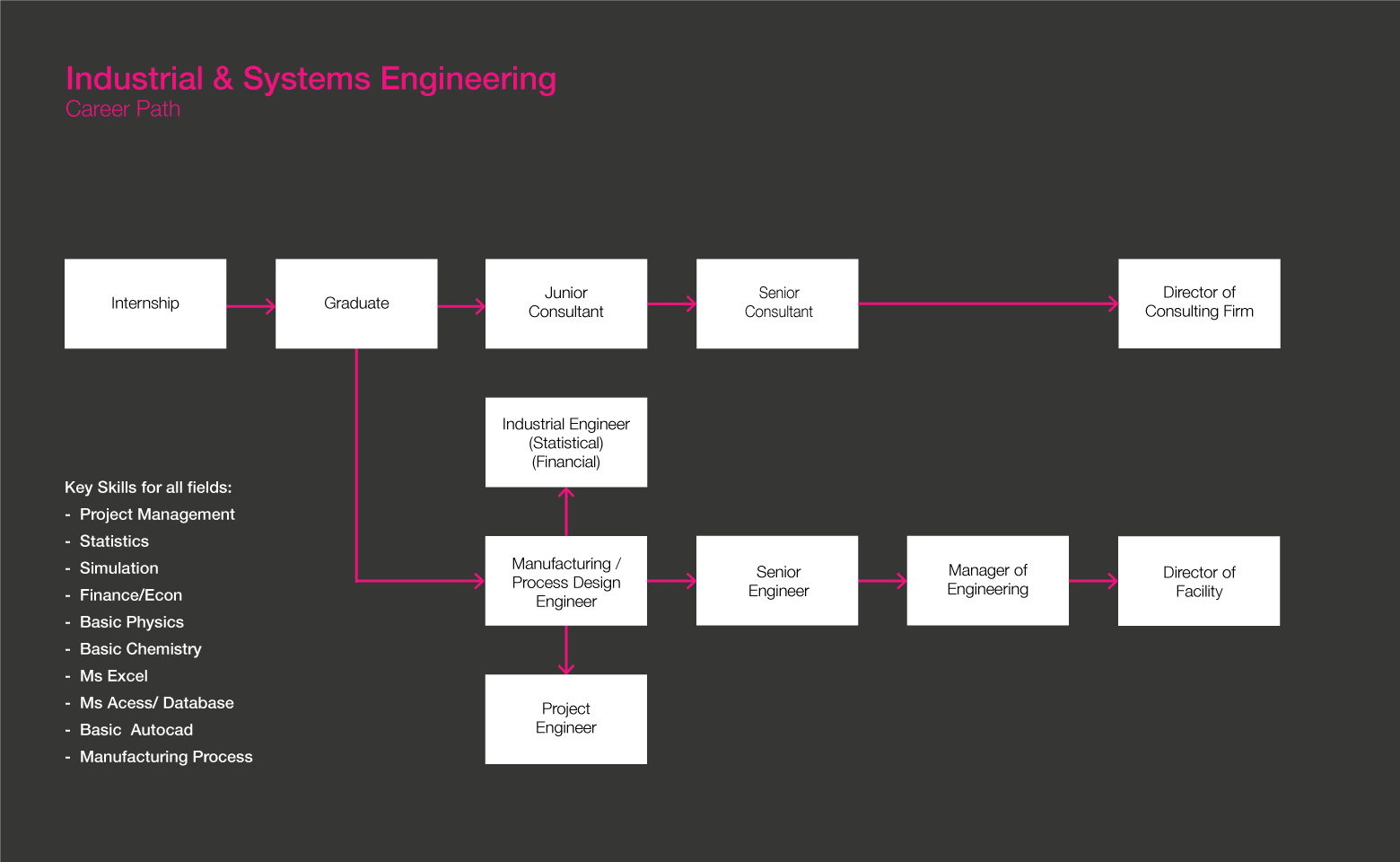
- Move into roles such as Senior Industrial Engineer, Operations Manager, Plant Manager, Director of Continuous Improvement, or Supply Chain Director
- Build expertise in a growing area such as automation, analytics, healthcare systems, or sustainability
- Mentor new engineers, speak at professional conferences, and stay active in IISE and related organizations
Websites:
- Institute of Industrial and Systems Engineers (IISE) - iise.org
- American Society for Quality (ASQ) - asq.org
- Lean Enterprise Institute - lean.org
- SME (Society of Manufacturing Engineers) - sme.org
- Association for Supply Chain Management (ASCM) - ascm.org
- Council of Supply Chain Management Professionals (CSCMP) - cscmp.org
- MHI (material handling and logistics industry association) - mhi.org
- INFORMS (operations research and analytics) - informs.org
- Institute for Healthcare Improvement - ihi.org
- Human Factors and Ergonomics Society - hfes.org
- Winter Simulation Conference - wintersim.org
- Society of Women Engineers - swe.org
- IndustryWeek - industryweek.com
- ABET - abet.org
Books:
- The Goal by Eliyahu M. Goldratt and Jeff Cox
- The Toyota Way by Jeffrey K. Liker
- Factory Physics by Wallace J. Hopp and Mark L. Spearman
- Lean Thinking by James P. Womack and Daniel T. Jones
- Cheaper by the Dozen by Frank B. Gilbreth Jr. and Ernestine Gilbreth Carey
If you find that being an Industrial Engineer isn't the right fit, your skills in analysis, process design, and problem solving transfer to many related careers.
- Manufacturing Engineer
- Operations Research Analyst
- Supply Chain Analyst
- Logistics Manager
- Quality Assurance Manager
- Management Analyst
- Project Manager
- Health Systems Analyst
- Data Analyst
- Human Factors Specialist
Newsfeed

Featured Jobs
Online Courses and Tools