






Spotlights
Underwriting Analyst, Commercial Underwriter, Personal Lines Underwriter, Risk Analyst, Underwriting Associate, Senior Underwriter, Property and Casualty Underwriter, Life Insurance Underwriter, Underwriting Specialist, Insurance Risk Analyst, Underwriting Manager
Every time someone buys car insurance, gets a homeowner's policy, or a business locks in coverage against disaster, there is a decision happening behind the scenes that most people never think about: should this be approved, and if so, at what price? That decision belongs to the Insurance Underwriter, the person whose judgment call determines whether an insurance company takes on a risk, and how much it charges for the privilege.
Insurance Underwriters evaluate applications for insurance coverage, digging into data about a person's health, driving record, property, or business operations to figure out how likely it is that the insurer will have to pay a claim. They work closely with insurance agents who bring in the applications, actuaries who build the statistical models behind pricing, and claims teams who can offer insight into real-world risk. An underwriter's decision affects real people's lives, from whether a first-time homebuyer gets affordable coverage to whether a small business can get the policy it needs to open its doors.
Using underwriting software, risk assessment models, credit and claims databases, and increasingly, predictive analytics tools, Insurance Underwriters turn raw data into confident decisions. Their work keeps insurance companies financially healthy while making sure coverage actually reaches the people and businesses that need it, striking a careful balance between protecting the company's bottom line and saying yes whenever the risk makes sense.
- Making decisions that directly protect people, families, and businesses from financial disaster
- Solving complex risk puzzles using data, judgment, and analytical thinking
- Building a stable, well-respected career in the financial services industry
- Growing expertise that opens doors to specialized, higher-paying roles over time
Working Schedule
Insurance Underwriters typically work standard business hours in an office setting, and many now work remotely or in hybrid arrangements since underwriting work is largely computer-based. The role is steady and predictable compared to many financial careers, though busy periods can occur around renewal deadlines, natural disasters that spike claims and applications, or end-of-quarter reporting. Most Insurance Underwriters are employed directly by insurance companies, though some work for brokerages or as independent consultants.
Typical Duties
- Reviewing insurance applications for completeness and accuracy
- Analyzing financial records, medical histories, or property information to assess risk
- Using underwriting software and risk models to calculate appropriate pricing
- Deciding whether to approve, deny, or modify terms of a policy
- Communicating with insurance agents about application requirements and decisions
- Setting premium rates based on risk level and company guidelines
- Reviewing renewal policies and adjusting terms based on updated risk information
- Consulting with actuaries on pricing models and risk trends
- Documenting underwriting decisions to meet compliance and audit standards
- Staying current on regulations affecting the type of insurance they underwrite
- Identifying red flags or inconsistencies that suggest fraud or high risk
- Balancing a caseload of applications against strict turnaround deadlines
Additional Responsibilities
- Training junior underwriters or underwriting assistants
- Collaborating with claims departments to understand real-world loss patterns
- Participating in continuing education to maintain underwriting licenses
- Reviewing and updating underwriting guidelines as market conditions shift
- Attending meetings with agents or brokers to explain underwriting decisions
- Analyzing portfolio-level risk trends across a book of business
- Supporting new product development with risk and pricing insight
- Staying informed on economic, legal, and industry trends affecting risk
An Insurance Underwriter's day often begins by reviewing a queue of new applications, sorting them by complexity and deadline. Straightforward personal lines applications, like a standard auto policy, might move quickly, while a complex commercial property application requires digging through financial statements, safety records, and prior claims history.
Midday is usually spent deep in analysis: running numbers through underwriting software, comparing risk factors against company guidelines, and sometimes calling an agent to ask for missing documentation or clarify an inconsistency in an application. Underwriters often consult with actuaries or senior underwriters on unusual or high-value cases where the right call is not obvious.
Afternoons might include finalizing decisions, documenting the reasoning behind each one, and communicating approvals, denials, or modified terms back to agents. Underwriters also spend time reviewing renewal policies, checking whether a client's risk profile has changed enough to adjust pricing, and staying on top of a steady stream of emails and case notes that keep every decision properly documented.
Soft Skills
- Strong analytical and critical thinking skills
- Attention to detail
- Sound judgment under uncertainty
- Clear written and verbal communication
- Organizational skills for managing multiple applications
- Comfort making decisions with incomplete information
- Ethical decision-making and integrity
- Patience with detailed, sometimes repetitive review work
- Collaboration with agents, actuaries, and claims teams
- Time management and ability to meet deadlines
- Confidence explaining and defending decisions
- Adaptability to changing regulations and guidelines
Technical Skills
- Underwriting and policy management software
- Risk assessment models and statistical reasoning
- Understanding of insurance products, terms, and regulations
- Financial statement analysis
- Data analysis using spreadsheets or specialized analytics tools
- Knowledge of relevant state and federal insurance regulations
- Familiarity with credit reports, claims databases, and inspection reports
- Basic actuarial and pricing concepts
- Fraud detection indicators
- Documentation and compliance recordkeeping
- Personal Lines Underwriter: Evaluates individual auto, home, and renters insurance applications
- Commercial Lines Underwriter: Assesses risk for businesses seeking property, liability, or other coverage
- Life Insurance Underwriter: Reviews health and lifestyle information to price life insurance policies
- Health Insurance Underwriter: Evaluates medical risk for individual or group health coverage
- Specialty Underwriter: Handles niche risks like marine, aviation, or cyber insurance
- Reinsurance Underwriter: Assesses risk for insurance companies buying coverage from other insurers
- Senior or Chief Underwriter: Oversees underwriting teams and sets broader underwriting policy
- Catastrophe Underwriter: Specializes in risks tied to natural disasters and large-scale events
- Property and casualty insurance companies
- Life and health insurance companies
- Insurance brokerages and agencies
- Reinsurance companies
- Specialty and surplus lines insurers
- Government insurance programs
- Insurance consulting firms
- Banks and financial institutions with insurance divisions
- Managing general agencies
- Insurtech companies building automated underwriting tools
Insurance Underwriters carry real financial responsibility, since a poor decision can expose a company to major losses or, on the flip side, deny fair coverage to someone who deserved it. That weight requires careful, consistent judgment, especially when working through a high volume of applications under deadline pressure.
The work is detail-heavy and can feel repetitive at times, requiring sustained focus on numbers, forms, and fine print rather than the more dynamic pace some other financial careers offer. Underwriters must also stay constantly current on shifting regulations, market conditions, and company guidelines, since a rule that applied last year might not apply today.
While the schedule is generally stable compared to many finance roles, periods following natural disasters, economic shifts, or major regulatory changes can bring sudden spikes in workload. Underwriters need to be comfortable holding firm on a well-reasoned decision, even when an agent or client pushes back, which takes both confidence and diplomacy.
- Growing use of artificial intelligence and machine learning to assist underwriting decisions
- Increased reliance on big data and alternative data sources for risk assessment
- Rising demand for underwriters skilled in cyber insurance risk
- Greater use of telematics and usage-based data in auto insurance underwriting
- Expansion of climate risk modeling due to increasing natural disasters
- Shift toward remote and hybrid underwriting roles
- Growth of automated underwriting for simple, low-risk policies
- Increased scrutiny on fair and unbiased use of data in underwriting decisions
- Rising demand for underwriters with strong data analytics skills
- More collaboration between underwriters and data science teams
Many Insurance Underwriters were the kids who liked puzzles, logic games, and figuring out how systems worked, whether that meant organizing collections, managing a budget for a school project, or enjoying math and strategy games. A knack for weighing pros and cons and making careful decisions often showed up early.
Others gravitated toward roles that involved responsibility and trust, like managing money for a club, working part-time jobs that required accuracy, or enjoying subjects like economics and statistics. A natural comfort with numbers, paired with a cautious, detail-oriented mindset, often pointed toward a career built on careful risk assessment.
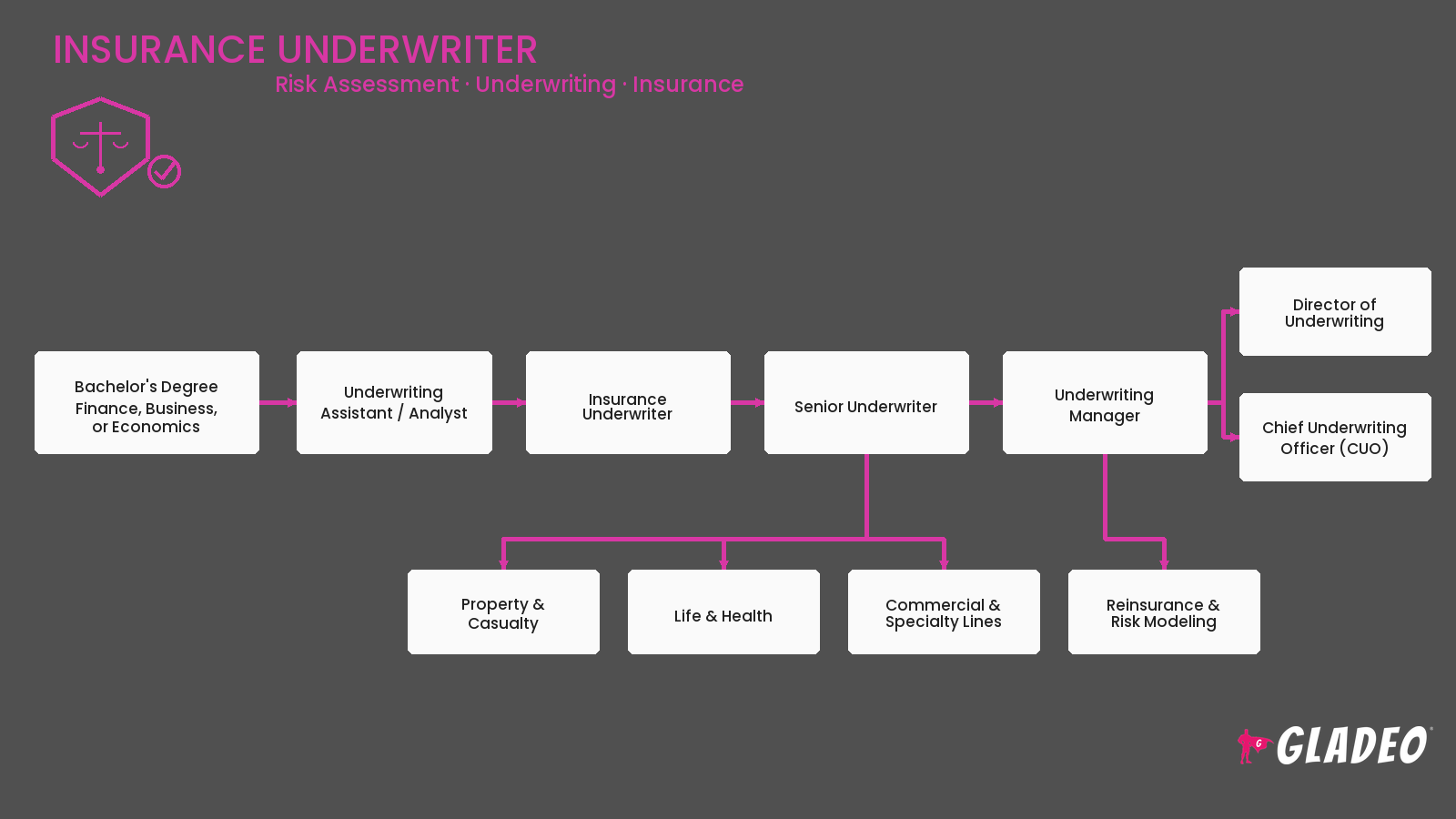
Most Insurance Underwriters need a bachelor's degree, often in finance, business, economics, or a related field, though some enter the profession with degrees in unrelated fields and strong analytical skills. Many companies provide on-the-job training programs for new underwriters, teaching company-specific systems, underwriting guidelines, and regulatory requirements. Professional certifications, such as the Chartered Property Casualty Underwriter (CPCU) designation, can strengthen career prospects and demonstrate expertise.
Students can take courses in relevant subjects such as:
- Finance
- Business Administration
- Economics
- Statistics
- Accounting
- Risk Management and Insurance
- Data Analytics
- Business Law
- Actuarial Mathematics
- Communications
Internships at insurance companies or brokerages give students valuable early exposure to how underwriting decisions actually get made. Many insurers also offer structured underwriting trainee programs for recent graduates, combining classroom learning with mentored, hands-on casework. Pursuing industry certifications throughout a career helps underwriters specialize and advance into senior or leadership roles.
- Take math, statistics, and economics courses to build strong analytical skills
- Study business and finance basics to understand how insurance companies operate
- Practice careful, detail-oriented work in school projects and part-time jobs
- Join a business, finance, or investing club at school
- Look into insurance industry internships or entry-level office roles
- Research risk management and insurance degree programs at colleges
- Attend career fairs and talk with professionals working in insurance
- Build strong writing and communication skills through English and speech classes
- Learn spreadsheet tools like Excel to prepare for data-heavy coursework and jobs
- Volunteer for roles that require managing budgets or handling responsibility
- Explore case studies about how insurance companies assess and price risk
- Practice explaining a decision or recommendation clearly and confidently
- Business schools with a dedicated risk management and insurance program
- Strong internship placement rates with insurance companies or brokerages
- Faculty with real industry experience in underwriting or risk management
- Coursework covering both quantitative analysis and insurance regulation
- Access to industry certification exam preparation, such as CPCU coursework
- Career services with active relationships with major insurance employers
- Opportunities to participate in case competitions or student insurance societies
- Programs offering data analytics or statistics electives
- Strong alumni network working in the insurance and financial services industry
- Flexible scheduling options for students balancing internships or part-time work
- Reasonable tuition relative to entry-level underwriting salaries
- Programs with connections to underwriting trainee or rotational programs
- Apply for underwriting trainee or rotational programs offered by major insurers
- Complete an internship with an insurance company, brokerage, or agency
- Highlight strong analytical and math skills prominently on your resume
- Search job boards and company career pages for entry-level underwriting assistant roles
- Network with insurance professionals through college career fairs and LinkedIn
- Consider starting in a related role, like claims or customer service, to learn the industry
- Prepare to discuss how you approach analyzing information and making decisions
- Research the specific insurance lines a company writes before interviewing
- Practice basic case-style interview questions about assessing risk scenarios
- Pursue an entry-level certification or coursework toward CPCU to show commitment
- Be open to relocating for opportunities at large regional or national insurers
- Follow up professionally after interviews to demonstrate reliability and interest
- Build a track record of sound, well-documented underwriting decisions
- Pursue professional designations like CPCU, CLU, or ARM to deepen expertise
- Specialize in a high-demand underwriting niche such as cyber or catastrophe risk
- Take on more complex or higher-value accounts as experience grows
- Develop strong relationships with agents and brokers who bring in business
- Mentor new underwriters and underwriting assistants
- Pursue leadership roles such as senior underwriter or underwriting manager
- Stay current on emerging risks and data tools to remain a valuable expert
Websites:
- The Institutes (CPCU and insurance education) - theinstitutes.org
- National Association of Insurance Commissioners - naic.org
- Insurance Information Institute - iii.org
- American Property Casualty Insurance Association - apci.org
- International Risk Management Institute - irmi.org
- Insurance Journal - insurancejournal.com
- Independent Insurance Agents & Brokers of America - iiaba.org
- Society of Insurance Trainers and Educators - insurancetrainers.org
- LOMA (Life Office Management Association) - loma.org
- Risk and Insurance Magazine - riskandinsurance.com
- National Underwriter - nationalunderwriter.com
- Insurance Careers Movement - insurancecareersmonth.org
Books:
- The Fundamentals of Risk Management and Insurance by Emmett J. Vaughan and Therese Vaughan
- Underwriting: The Efficient Frontier of the Insurance Industry by David Sandberg
- Risk Management and Insurance by Scott Harrington and Gregory Niehaus
- How to Speak Insurance by Bob Rusbuldt
- The Essentials of Risk Management by Michel Crouhy, Dan Galai, and Robert Mark
If you find that being an Insurance Underwriter isn't the right fit, your analytical and risk assessment skills can transfer to many related careers.
- Actuary
- Loan Underwriter
- Risk Manager
- Financial Analyst
- Claims Adjuster
- Insurance Agent
- Compliance Officer
- Credit Analyst
- Data Analyst
- Insurance Broker
Newsfeed

Featured Jobs
Online Courses and Tools