





Spotlights
Irrigation Technician, Irrigation Engineer, Water Resource Specialist, Agricultural Irrigation Manager, Irrigation System Designer, Landscape Irrigation Specialist, Drip Irrigation Technician, Sprinkler System Installer, Irrigation Project Coordinator, Water Management Specialist, Irrigation Consultant, Irrigation Systems Operator
Imagine a farm or golf course flourishing even during dry spells because every drop of water is delivered just where it's needed. Irrigation Specialists make this possible by designing and managing precision watering systems that keep plants healthy and landscapes vibrant.
Irrigation Specialists spend their days planning, installing, and maintaining irrigation systems to ensure crops, gardens, and green spaces receive the right amount of water. They collaborate with farmers, landscapers, engineers, and environmental scientists to tailor solutions that fit the local climate, soil, and plant needs. Their work leads to improved crop yields, water savings, and sustainable land use.
Using tools like soil moisture sensors, computer-aided design software, and automated control systems, Irrigation Specialists fine-tune water delivery for efficiency and environmental protection. Their expertise is crucial in conserving water resources while supporting agriculture and green spaces that communities rely on every day.
- Helping farmers grow healthy crops and increase food production sustainably.
- Conserving water and protecting natural resources through smart irrigation solutions.
- Working outdoors in varied environments while applying technical and problem-solving skills.
- Seeing the direct impact of your work in thriving landscapes and satisfied clients.
Working Schedule
Irrigation Specialists typically work full-time hours, often during regular business days, but schedules can vary with the season. During planting and growing seasons, they may work longer or irregular hours to install or repair systems and meet urgent farming needs. The job includes both indoor planning and outdoor hands-on work, sometimes in challenging weather conditions. Many work for agricultural companies, landscaping firms, or government agencies, while some operate as independent contractors or consultants.
Typical Duties
- Assess fields and landscapes to determine irrigation needs and water sources.
- Design and plan irrigation systems using CAD software and engineering principles.
- Install irrigation equipment such as pipes, sprinklers, drip lines, pumps, and valves.
- Calibrate and program automated irrigation controllers based on weather and soil data.
- Monitor system performance and adjust schedules to optimize water use and crop health.
- Troubleshoot and repair irrigation system malfunctions or leaks promptly.
- Train farm staff or clients on system operation and maintenance.
- Conduct soil and water tests to inform irrigation strategies.
- Ensure systems comply with environmental regulations and water use restrictions.
- Collaborate with agricultural scientists, landscapers, and engineers on water management projects.
- Document system installations, maintenance, and repairs for records and planning.
- Stay updated on new irrigation technologies and best practices.
Additional Responsibilities
- Manage irrigation system budgets and order necessary parts or equipment.
- Perform regular inspections to prevent system failures or inefficiencies.
- Advise clients or managers on drought-resistant planting and water-saving practices.
- Report on water usage and efficiency metrics to supervisors or regulatory bodies.
- Participate in community education about water conservation and sustainable agriculture.
- Coordinate with local water authorities regarding water rights and permits.
- Develop emergency response plans for irrigation system failures.
- Support research projects on improving irrigation methods and technology.
In the morning, an Irrigation Specialist reviews soil moisture reports and weather forecasts to plan system adjustments or installations for the day. They meet with farmers or landscapers to discuss specific watering needs and inspect equipment for any damage.
Midday is often spent outdoors installing new irrigation components or repairing existing systems. They may dig trenches, lay pipes, or program smart controllers to ensure efficient water delivery. Communication with team members and clients is constant to coordinate efforts and troubleshoot issues.
By afternoon, the specialist analyzes data collected from sensors or system logs to fine-tune irrigation schedules. They document their work, prepare reports, and sometimes provide training or demonstrations on system use. If urgent problems arise, they respond quickly to minimize crop stress or water waste.
Soft Skills
- Problem-solving to diagnose and fix irrigation issues efficiently.
- Attention to detail for designing and maintaining precise watering systems.
- Good communication to explain technical information clearly to clients and team members.
- Adaptability to work in changing weather and field conditions.
- Time management for balancing multiple projects and seasonal demands.
- Teamwork for collaborating with agricultural experts and contractors.
- Customer service to build trust and meet client needs.
- Physical stamina for outdoor manual labor and equipment handling.
- Analytical thinking to interpret soil and water data.
- Patience and persistence when working through complex system problems.
- Environmental awareness to promote sustainable water use.
- Organizational skills for managing schedules, records, and supplies.
Technical Skills
- Proficiency with irrigation system components such as pumps, valves, and sprinklers.
- Experience using computer-aided design (CAD) software for system planning.
- Knowledge of soil science and hydrology to assess water needs.
- Ability to program and calibrate automated irrigation controllers.
- Skill in using soil moisture sensors and weather monitoring tools.
- Understanding of local water regulations and environmental compliance.
- Competence in troubleshooting mechanical and electrical irrigation equipment.
- Familiarity with water conservation techniques and technologies.
- Use of GPS and mapping tools for system layout.
- Basic maintenance and repair skills for irrigation hardware.
- Agricultural Irrigation Specialist: Focuses on irrigation systems for crop fields and farms.
- Landscape Irrigation Specialist: Designs and maintains watering systems for parks, gardens, and lawns.
- Drip Irrigation Technician: Specializes in installing and managing drip irrigation to deliver water directly to plant roots.
- Irrigation System Designer: Plans and engineers irrigation layouts using CAD and modeling software.
- Irrigation Maintenance Technician: Concentrates on repairing and servicing existing irrigation systems.
- Water Resource Specialist: Manages water supply and usage planning for irrigation projects.
- Irrigation Automation Specialist: Develops and programs automated control systems for efficient irrigation.
- Environmental Irrigation Consultant: Advises on sustainable irrigation practices and regulatory compliance.
- Agricultural farms and cooperatives
- Landscaping and lawn care companies
- Golf courses and sports facilities
- Nurseries and greenhouses
- Municipal parks and recreation departments
- Environmental and water conservation agencies
- Irrigation equipment manufacturers and suppliers
- Agricultural extension services
- Consulting engineering firms
- Government agricultural departments
- Agricultural research institutions
- Irrigation system installation and service contractors
Irrigation Specialists often face pressure to quickly resolve system failures, especially during critical growing periods, to prevent crop damage or water waste. Meeting tight deadlines and managing multiple projects simultaneously is common, requiring strong organizational skills and calmness under stress.
Work hours can extend beyond the typical 9-to-5 schedule, especially in peak seasons or when responding to emergencies. Outdoor work exposes specialists to weather extremes, including heat, rain, or cold, and requires physical endurance.
The job demands both technical precision and hands-on labor. Specialists must stay updated on evolving irrigation technologies and environmental regulations, which means ongoing learning and adapting to new challenges. While the work can be demanding, the satisfaction of supporting sustainable agriculture and water conservation is a strong motivator.
- Growing use of smart irrigation systems with sensors and automation to optimize water use.
- Increased focus on water conservation due to climate change and drought concerns.
- Integration of data analytics and weather forecasting into irrigation scheduling.
- Development of drip and micro-irrigation technologies for precise watering.
- Rising adoption of renewable energy-powered irrigation pumps and controls.
- Use of remote monitoring and mobile apps for system management.
- Stricter environmental regulations on water withdrawal and runoff.
- Expansion of sustainable agriculture practices influencing irrigation design.
- Greater collaboration between irrigation specialists and environmental scientists.
- Advances in soil moisture sensing and real-time data collection.
Many Irrigation Specialists were curious about how plants grow and how water helps them thrive from a young age. They often enjoyed gardening, farming, or working with water systems at home or in school projects.
Interest in mechanical systems, problem-solving, and spending time outdoors were common childhood traits. Early experiences with fixing devices or helping on farms sparked their passion for combining technology with nature to support healthy landscapes.
Becoming an Irrigation Specialist involves a mix of formal education, hands-on training, and practical experience. Many enter the field with a high school diploma plus technical training in agriculture, horticulture, or environmental science. Some pursue degrees in agricultural engineering, water resource management, or related fields to advance their knowledge and career opportunities.
Students can take courses in relevant subjects such as:
- Agriculture and Horticulture
- Soil Science
- Environmental Science
- Hydrology and Water Management
- Mechanical and Electrical Systems
- Computer-Aided Design (CAD)
- Botany and Plant Science
- Sustainable Agriculture Practices
- Irrigation System Design and Installation
- Data Analysis and Sensors Technology
Hands-on experience through internships, apprenticeships, or on-the-job training is essential to develop practical skills. Building a portfolio of projects and gaining certifications in irrigation technology or water management can open doors to better positions and consulting roles. Lifelong learning is important to keep up with evolving technologies and regulations.
- Take science courses like biology, chemistry, and environmental science to build foundational knowledge.
- Enroll in agriculture or horticulture classes if available at school.
- Join clubs or organizations focused on gardening, farming, or environmental stewardship.
- Gain experience with technology and computer applications, including CAD software.
- Volunteer or intern with local farms, landscaping companies, or water agencies to get hands-on exposure.
- Attend workshops or summer programs in irrigation or water conservation.
- Develop strong math skills for system design and data analysis.
- Explore online tutorials and videos about irrigation systems and agricultural technology.
- Connect with local agricultural extension offices for resources and mentoring.
- Consider part-time jobs in landscaping or farm work to understand irrigation in practice.
- Choose programs offering hands-on training with real irrigation equipment.
- Look for curricula that include soil science, water management, and CAD design.
- Select schools with partnerships or internships in agriculture or landscaping industries.
- Verify if the program offers certifications recognized by irrigation industry associations.
- Seek instructors with field experience and strong industry connections.
- Prioritize programs that cover environmental regulations and sustainable practices.
- Find courses that teach the latest irrigation automation and sensor technology.
- Check if the program supports career services and job placement assistance.
- Consider schools with strong ties to local agriculture and water resource organizations.
- Look for opportunities to participate in research or pilot projects on irrigation technology.
- Evaluate the balance between classroom theory and practical fieldwork.
- Explore online or hybrid learning options to supplement hands-on education.
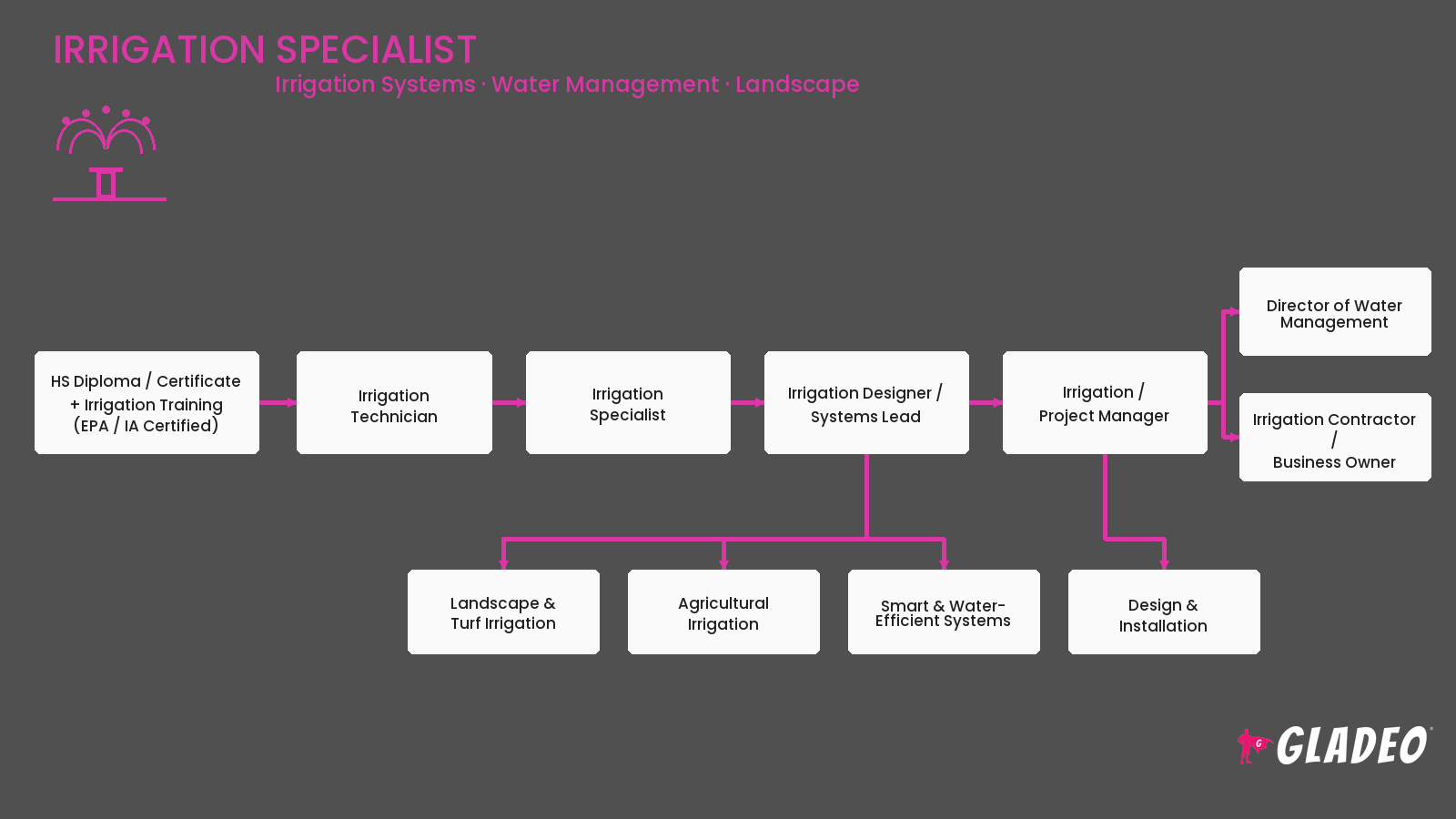
- Apply for entry-level positions such as Irrigation Technician Assistant or Field Technician.
- Build a portfolio documenting any school projects, internships, or volunteer work related to irrigation.
- Network with professionals through agriculture fairs, trade shows, and local extension offices.
- Prepare for interviews by learning about local crops, climate, and water issues.
- Gain proficiency with basic irrigation tools and software in practical settings.
- Volunteer for extra tasks to learn about system installation and maintenance.
- Seek mentorship from experienced Irrigation Specialists or engineers.
- Obtain certifications like Certified Irrigation Technician (CIT) or similar credentials.
- Demonstrate reliability and problem-solving skills in fieldwork and client interactions.
- Keep a log of your work and feedback to track your learning and improvements.
- Stay updated on industry trends and new irrigation products.
- Show enthusiasm for sustainable water use and efficient agriculture.
- Gain expertise with advanced irrigation technologies and automation systems.
- Develop leadership skills to manage teams or projects effectively.
- Build relationships with agricultural clients and vendors for referrals and repeat business.
- Pursue certifications or advanced degrees in water resource management or agricultural engineering.
- Expand knowledge in environmental regulations and sustainability consulting.
- Transition into roles like Irrigation Project Manager or Water Resource Consultant.
- Contribute to research and development of innovative irrigation methods.
- Establish your own irrigation consulting or installation business for greater independence.
Websites:
- Irrigation Association (irrigation.org)
- American Society of Agricultural and Biological Engineers (asae.org)
- National Ground Water Association (ngwa.org)
- USDA Natural Resources Conservation Service (nrcs.usda.gov)
- Water Education Foundation (watereducation.org)
- Association of State Floodplain Managers (floods.org)
- American Water Works Association (awwa.org)
- Environmental Protection Agency - Water Topics (epa.gov/water)
- Landscape Irrigation Contractors of America (lica.org)
- Agricultural Water Management journal (agwatermanagementjournal.com)
- Soil Science Society of America (soils.org)
- National Sustainable Agriculture Coalition (sustainableagriculture.net)
- AgriLife Extension (agrilifeextension.tamu.edu)
- Smart Irrigation Association (smartirrigation.org)
Books:
- Drip Irrigation for Agriculture: Untold Stories of Efficiency, Innovation and Development by Jean Philippe Venot
- Designing and Managing Your Irrigation System by Robert M. Hagan
- Principles of Agricultural Engineering Volume 2 by Richard O. Schultheiss
- Water for Agriculture: Irrigation Management and Hydraulic Structures by G. J. Gasim
- Irrigation Engineering and Hydraulic Structures by Santosh Kumar Garg
If you’re passionate about water management, agriculture, or environmental sustainability but want a different path, there are many related careers that use similar skills and interests.
- Agricultural Technician
- Landscape Architect
- Water Resource Manager
- Environmental Scientist
- Hydrologist
- Farm Manager
- Agricultural Engineer
- Soil Scientist
- Landscape Contractor
- Environmental Consultant
Click here to download the infographic
Newsfeed

Featured Jobs
Online Courses and Tools