






Spotlights
Licensed Massage Therapist (LMT), Bodywork Therapist, Bodyworker, Sports Massage Therapist, Medical Massage Therapist, Spa Therapist, Clinical Massage Therapist, Neuromuscular Therapist, Prenatal Massage Therapist, Therapeutic Massage Practitioner, Massage and Bodywork Professional
Think about the last time your shoulders were so tight from a stressful week that you could barely turn your head, or the last time a long run left your legs feeling like concrete. Now imagine someone who knows exactly which muscle is causing the trouble, and exactly how to release it. Massage Therapists use skilled, caring touch to melt away pain, ease stress, help athletes recover, and give people a rare hour in their week where they can truly breathe. For many clients, a session is the difference between dreading the day and getting back to the things they love.
Massage Therapists are licensed health and wellness professionals who work one-on-one with clients to relieve muscle tension, reduce pain, improve movement, and support overall well-being. A typical day might include a deep tissue session for a construction worker with a sore lower back, a gentle prenatal massage for an expecting mom, a sports massage for a high school or college athlete before a big meet, and a relaxing Swedish massage for someone who just needs to unwind. They talk with each client before every session about goals, health history, and comfort levels, then design a treatment around what that person needs. Along the way they collaborate with chiropractors, physical therapists, doctors, personal trainers, and spa teams to make sure clients get well-rounded care.
Using their hands, forearms, and elbows along with tools like massage tables, hot stones, cupping sets, bolsters, oils, and lotions, Massage Therapists combine detailed knowledge of anatomy with a trained sense of touch. They can feel a knot, a tight band of muscle, or a restricted joint and know how to work with it safely. Their work matters because pain and chronic stress touch nearly every part of life, from sleep and mood to athletic performance and job productivity. A great Massage Therapist builds trust, protects client safety and privacy, and sends people home feeling lighter, stronger, and more like themselves.
- Seeing a client walk in hurting and walk out moving freely, often with a big sigh of relief
- Being trusted with people's health and well-being, and building long-term relationships with regular clients
- Having the freedom to work in many settings, set your own schedule, and even build your own business
- Using your hands, your brain, and your heart in a career that keeps you active and learning
- Working in a field that supports people through pain recovery, pregnancy, athletic goals, and stress relief
Working Schedule
Massage Therapists often work part-time or a mix of full-time hours, because giving massages is physically demanding and many therapists cap their schedule at around 20 to 30 hours of hands-on sessions each week, with the rest of their time spent on scheduling, paperwork, laundry, marketing, and room setup. Hours depend heavily on the setting. Spas, massage franchises, and resorts usually need therapists on evenings, weekends, and holidays, since that is when clients are free. Clinics and chiropractic offices often keep more standard daytime hours. Many therapists are self-employed, renting a treatment room or running a studio of their own, which gives them flexibility but also means they handle their own bookings, taxes, insurance, and supplies. Some travel to clients' homes, offices, sporting events, or corporate wellness days with a portable massage table.
Typical Duties
- Interviewing clients about their health history, pain areas, stress levels, and goals before each session
- Checking for conditions that make massage unsafe or require changes, known as contraindications
- Explaining what will happen during the session and getting clear consent before beginning
- Assessing posture, range of motion, and muscle tension to decide which techniques to use
- Performing techniques such as Swedish, deep tissue, sports, prenatal, trigger point, myofascial release, and neuromuscular massage
- Using draping so clients are covered and comfortable, uncovering only the area being worked on
- Adjusting pressure, speed, and technique based on live feedback from the client
- Recommending stretches, strengthening movements, hydration, heat, or ice to continue progress at home
- Writing session notes that record what was done, how the client responded, and any follow-up plans
- Cleaning and sanitizing the treatment room, table, linens, and tools between every client
- Scheduling appointments, handling payments, and managing the client calendar
- Referring clients to doctors, physical therapists, or other providers when something is outside massage scope
Additional Responsibilities
- Marketing services through a website, social media, referrals, and community events
- Keeping up with state license renewal and required continuing education hours
- Carrying professional liability insurance and following local and state business rules
- Tracking income, expenses, and taxes if self-employed
- Communicating with insurance companies or medical offices for clients receiving medical or injury-related massage
- Ordering and stocking oils, lotions, linens, hot stone equipment, and other supplies
- Practicing personal body care, stretching, and strength training to protect their own hands, wrists, and back
- Mentoring new therapists or training interns and students in clinic settings
A Massage Therapist's day often starts before the first client arrives. They check the schedule, read intake forms or session notes from returning clients, and prepare the treatment room by warming the table, laying fresh linens, setting the lighting and music, and putting out oils or other supplies. Many do a few minutes of stretching and wrist and shoulder warm-ups so their own body is ready for hours of work. A first appointment might be a regular client with chronic neck tension, so the therapist reviews what worked last time and plans how to build on it.
Midday is the heart of the job. Each session begins with a short conversation about how the client is feeling, then the therapist leaves the room so the client can get on the table under the sheet. During the massage, the therapist works through the body using the planned techniques, constantly watching for tension changes, checking pressure comfort, and adapting on the fly. One hour might be a deep tissue treatment for a runner with tight hips, the next a calm, flowing Swedish massage for someone who has been under major stress. Between clients, the therapist wipes down surfaces, washes hands, changes linens, writes notes, and takes a moment to drink water and reset.
Afternoons and evenings are often the busiest, since many people book after work or school. A therapist may see a few more clients, answer booking messages, and follow up with a chiropractor about a shared patient. After the final session, they handle laundry, restock supplies, finish documentation, and plan tomorrow. Self-employed therapists also use this time for marketing, bookkeeping, and checking in with clients about future appointments.
Soft Skills
- Empathy and genuine care for others
- Active listening and clear communication
- Professionalism, trustworthiness, and respect for privacy
- Strong personal and professional boundaries
- Ability to put clients at ease, including nervous first-timers
- Patience and a calm, grounding presence
- Physical stamina and body awareness
- Attention to detail and observation
- Time management and punctuality
- Adaptability when clients have different needs and comfort levels
- Cultural sensitivity and inclusive care
- Self-motivation and business sense for independent work
Technical Skills
- Detailed knowledge of anatomy, muscles, bones, and joints
- Knowledge of physiology, pathology, and conditions that affect massage safety
- Mastery of multiple techniques such as Swedish, deep tissue, sports, prenatal, and myofascial release
- Palpation, or finding and assessing tissue by touch
- Proper body mechanics and ergonomics to protect the therapist's own hands and back
- Client assessment and treatment planning
- Draping and safe, ethical client positioning
- Sanitation, infection control, and room hygiene
- Documentation methods such as SOAP notes
- Use of tools such as hot stones, cupping, massage tools, and bolsters
- Relaxation or Swedish Massage Therapist: Uses long, flowing strokes to reduce stress and promote calm, often in spas and wellness centers
- Deep Tissue Therapist: Works on deeper layers of muscle and connective tissue to release chronic tension and knots
- Sports Massage Therapist: Helps athletes warm up, recover, and prevent injury, often working with school, college, or pro teams and events
- Prenatal Massage Therapist: Specializes in safe, comfortable massage techniques for people during pregnancy
- Medical or Clinical Massage Therapist: Works with doctors, chiropractors, and physical therapists to treat injuries, pain conditions, and rehabilitation goals
- Neuromuscular and Trigger Point Therapist: Targets specific muscle knots and pain patterns that refer discomfort to other parts of the body
- Oncology and Palliative Massage Therapist: Offers specially trained, gentle bodywork for people in cancer treatment or hospice care
- Mobile or Corporate Massage Therapist: Travels to homes, offices, and events to bring seated or table massage to clients where they are
- Day spas and resort spas
- Massage franchises and wellness studios
- Chiropractic offices
- Physical therapy and rehabilitation clinics
- Hospitals, cancer centers, and hospice programs
- Sports teams, athletic training rooms, and fitness centers
- Cruise lines, hotels, and tourism destinations
- Corporate wellness programs
- Salons and med spas
- Airports and event venues with chair massage services
- Massage schools and training programs
- Private practices and home-based studios
Massage is physically demanding work. Therapists use their hands, thumbs, forearms, and whole body for hours at a time, and repetitive strain injuries are a genuine risk. This is why smart therapists learn proper body mechanics early, limit how many sessions they give in a day, stay in good shape, and take their own self-care seriously. Many therapists find that building a schedule they can sustain for decades matters more than squeezing in as many clients as possible.
The job also requires strong professional boundaries and ethics. Therapists must respect client privacy, always get consent, keep sessions strictly professional, and know when a condition or request is outside their scope of practice. Clients are trusting you with their health and their bodies, so clear communication and honesty are essential. Some clients will share emotional stories or arrive in pain, and learning to be compassionate without taking on their stress takes practice.
The business side can be a surprise. New therapists may start in spas or franchises with unpredictable schedules, tip-based income, and evening or weekend hours. Self-employed therapists enjoy independence but must build a client base, market themselves, handle taxes and insurance, and absorb the income swings that come with cancellations and slow seasons. Licensing requirements and continuing education also take time and money, but they keep professionals credible and clients safe.
- Growing demand for massage as part of pain management, stress relief, and overall wellness plans
- More integration of massage into healthcare settings such as hospitals, cancer centers, and rehabilitation clinics
- Rising interest in sports recovery, mobility work, and percussive and cupping-based techniques
- Increased use of online scheduling, digital intake forms, and automated client reminders
- Greater focus on therapist ergonomics and career longevity
- Specialization in areas such as prenatal, oncology, geriatric, and trauma-informed massage
- Growth of memberships and subscription models at massage studios
- Expanded use of research from groups like the Massage Therapy Foundation to support evidence-based practice
- Corporate wellness programs bringing chair massage to workplaces and events
- Stronger emphasis on informed consent, boundaries, and inclusive, trauma-informed care
Many Massage Therapists were the friend or family member who was always asked for a shoulder rub or back scratch after a long day. They tended to be naturally caring and observant, noticing when someone was stressed or hurting. Many were involved in sports, dance, gymnastics, or yoga, where they learned firsthand how much muscles and recovery matter, and some had their own injuries and found healing through massage, physical therapy, or athletic training.
In school, they often enjoyed biology, health, and physical education, and they liked hands-on learning more than sitting still for long lectures. Some volunteered at nursing homes, helped care for relatives, or served as team managers or athletic trainers' helpers. Others simply loved the idea of a career that blends science, creativity, and kindness, and offers the chance to help people feel better every day.
Becoming a Massage Therapist usually requires completing a state-approved massage therapy program at a technical school, community college, or private massage school. Programs generally include several hundred hours of study, with many states requiring 500 or more hours, and some requiring 750 to 1,000 hours or more. After graduating, most states require passing a licensing exam, most commonly the Massage and Bodywork Licensing Examination (MBLEx) created by the Federation of State Massage Therapy Boards, along with a background check and an application to the state licensing board. Because rules differ from state to state, including which exam is used and whether a license is required at all, it is important to check the requirements where you plan to work.
Students can take courses in relevant subjects such as:
- Anatomy and Physiology
- Kinesiology and Biomechanics
- Pathology and Contraindications
- Swedish and Therapeutic Massage Techniques
- Deep Tissue and Myofascial Release
- Sports and Prenatal Massage
- Ethics, Boundaries, and Professional Communication
- Business Practices and Marketing for Massage Therapists
- Hydrotherapy and Spa Treatments
- First Aid, CPR, and Infection Control
Hands-on practice is the heart of training. Students give supervised massages in school clinics, get feedback from instructors, and learn to adapt techniques to different bodies and needs. Many programs include student clinics open to the public, which build confidence and prepare students for real client situations. After licensure, many therapists earn extra training in specialties like sports, prenatal, oncology, or medical massage. Board certification through the National Certification Board for Therapeutic Massage and Bodywork (NCBTMB) is a respected extra credential. Continuing education is required to renew a license in most states, so learning never stops.
- Take biology, anatomy, physiology, and health classes to build your foundation in how the body works
- Enroll in psychology or communication courses to practice reading people and building trust
- Play sports, dance, do yoga, or work out so you understand movement and muscles firsthand
- Volunteer with a school athletic trainer, sports team, nursing home, or community health event
- Take a CPR and first aid course, which many programs and employers value
- Get a massage yourself from a licensed therapist to see what a professional session feels like
- Interview a licensed Massage Therapist about their schedule, training, and business setup
- Shadow a therapist at a spa, clinic, or chiropractic office if the opportunity exists
- Take a business, entrepreneurship, or marketing class, since many therapists run their own practice
- Look up your state massage board to learn the hour requirements and licensing steps
- Practice good posture, core strength, and stretching now to build habits that protect your hands and back
- Build customer service experience through jobs in spas, salons, gyms, or hospitality
- Approval by your state massage board, so graduates can sit for the licensing exam
- Accreditation from a recognized body such as the Commission on Massage Therapy Accreditation (COMTA) where available
- Total program hours that meet or exceed your state's requirement
- Strong MBLEx pass rates and exam preparation support
- A student clinic that offers real-world practice with supervised clients
- Instructors who are licensed, experienced therapists
- Well-rounded training in multiple styles, including deep tissue, sports, and prenatal
- Coverage of ethics, boundaries, consent, and professional communication
- Business and marketing classes that prepare you for self-employment
- Job placement help and connections with local spas, clinics, and wellness businesses
- Reasonable class sizes with plenty of table time and individual feedback
- Clear costs, financial aid options, and flexible day or evening schedules
- Pass the MBLEx and get your state license before applying, since employers hire licensed therapists only
- Apply for entry-level roles such as Massage Therapist, Spa Therapist, Wellness Therapist, or Bodywork Associate
- Search job boards like Indeed and LinkedIn, plus spa and massage franchise career pages
- Start at a spa, franchise, or wellness studio that provides clients and training while you build experience
- Talk with chiropractors, physical therapists, and gym owners about contract or part-time positions
- Create a short professional resume highlighting your training hours, specialties, and customer service experience
- Offer practice sessions at community events, sports tournaments, or charity races to build a reputation
- Build a simple website and social media profile showing your services, credentials, and booking information
- Prepare for a working interview, where you may be asked to give a short demonstration massage
- Join AMTA or ABMP for networking, insurance, and job listings
- Ask satisfied clients for testimonials and referrals, which are the lifeblood of this career
- Carry professional liability insurance and be ready to show your license and credentials
- Build a loyal base of regular clients through consistent quality, warm communication, and reliability
- Specialize in an area like sports, prenatal, oncology, or medical massage to command higher rates and attract referrals
- Earn advanced certifications and board certification to strengthen your credibility
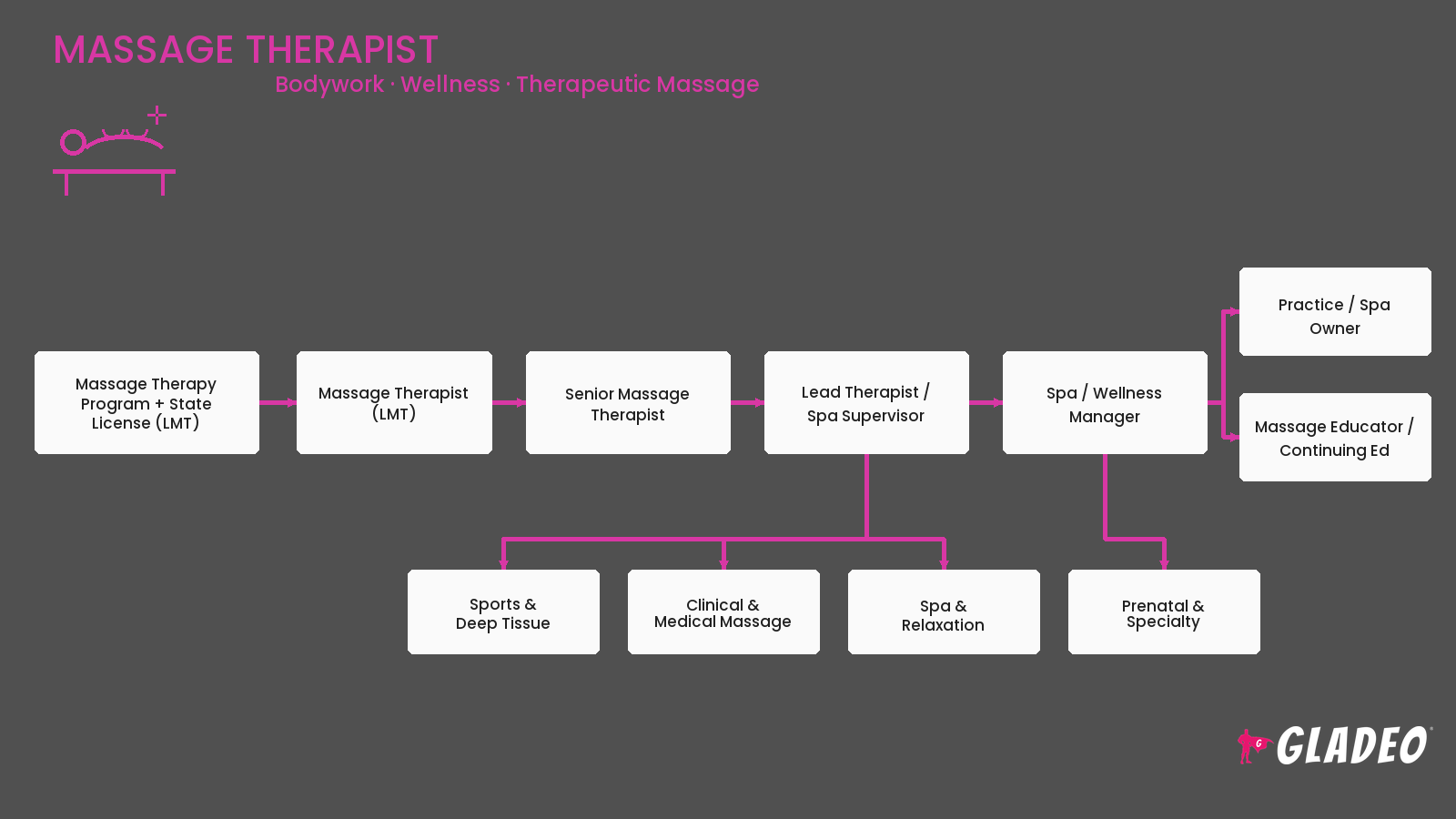
- Move into lead therapist, spa manager, clinic director, or franchise owner positions
- Open your own private practice or studio and hire other therapists
- Teach at a massage school or lead continuing education workshops
- Build referral partnerships with doctors, physical therapists, trainers, and sports teams
- Write, speak, or contribute to research and industry publications to become a recognized expert
"As I ventured into private practice as a massage therapist I knew it was going to be important to stand out. I asked myself questions like who am I, who are the types of clients that I want to attract, what is going to be the " look and feel" of my practice; my "brand". I started from there and worked outward. This gave me a solid foundation to build from." Morgan Henry, Anchor Bodyworks
Websites:
- American Massage Therapy Association (AMTA) - amtamassage.org
- Associated Bodywork & Massage Professionals (ABMP) - abmp.com
- Federation of State Massage Therapy Boards (FSMTB) - fsmtb.org
- National Certification Board for Therapeutic Massage and Bodywork (NCBTMB) - ncbtmb.org
- Commission on Massage Therapy Accreditation (COMTA) - comta.org
- Massage Therapy Foundation - massagetherapyfoundation.org
- Massage Magazine - massagemag.com
- International Spa Association (ISPA) - experienceispa.com
- Anatomy Trains - anatomytrains.com
- Visible Body - visiblebody.com
- Kenhub Anatomy Learning - kenhub.com
- National Center for Complementary and Integrative Health - nccih.nih.gov
Books:
- Trail Guide to the Body by Andrew Biel
- Mosby's Fundamentals of Therapeutic Massage by Sandy Fritz
- The Trigger Point Therapy Workbook by Clair Davies and Amber Davies
- Anatomy Trains by Thomas Myers
- Massage Therapy: Principles and Practice by Susan G. Salvo
If you find that being a Massage Therapist isn't the right fit, your skills in anatomy, hands-on care, and building trust can open doors to many related careers.
- Physical Therapist Assistant
- Athletic Trainer
- Chiropractic Assistant
- Occupational Therapy Assistant
- Personal Trainer
- Yoga or Pilates Instructor
- Esthetician or Spa Manager
- Acupuncturist
- Exercise Physiologist
- Rehabilitation Aide

Newsfeed

Featured Jobs
Online Courses and Tools