





Spotlights
Diagnostic Radiologist, Interventional Radiologist, Neuroradiologist, Pediatric Radiologist, Musculoskeletal Radiologist, Breast Imaging Radiologist, Nuclear Medicine Physician, Radiology Attending Physician, Teleradiologist, Imaging Physician, Emergency Radiologist, Chief of Radiology
When you break your wrist, a doctor needs to see through your skin to know exactly what is wrong. When someone arrives at the emergency room with a terrible headache, a team must find out in minutes whether it is a bleed in the brain. When a patient has a tumor that needs treatment, someone has to find it, measure it, and track whether the treatment is working. In each case, the person who finds the answer inside the image is a Radiologist. They are physicians who can look inside the human body without a single cut, and their sharp eyes and careful thinking guide the care of millions of patients every year.
Radiologists are medical doctors who specialize in interpreting images of the body, including X-rays, CT scans, MRI scans, ultrasound, mammograms, and nuclear medicine scans. They are often called the doctor's doctor, because physicians in every specialty, from emergency medicine and surgery to cancer care and pediatrics, rely on them to answer the hardest questions. A Radiologist studies the pictures, compares them with earlier scans, and writes a report that tells the care team what is going on, whether that is a broken bone, a pneumonia, a clot, or a tumor. They also talk directly with colleagues, call urgent findings in right away, and help decide which imaging test is the best one for each patient. A growing group, called interventional radiologists, go even further by using imaging as a guide to perform procedures through tiny openings, such as opening blocked blood vessels, treating tumors, or placing drainage tubes, often replacing major surgery.
To do this work, Radiologists use powerful scanners, advanced software that lets them scroll through hundreds of slices of the body and view them in 3D, and increasingly, artificial intelligence tools that flag suspicious spots, prioritize urgent cases, and measure changes over time. They draw on years of training in anatomy, physiology, physics, and disease. Their work matters because a correct and early diagnosis can change everything, from catching a cancer when it is easiest to treat, to making sure a child with stomach pain gets the right treatment, to avoiding unnecessary surgery. Many patients never meet their Radiologist, but their answers are at the center of the care they receive.
- Solving medical mysteries every day by spotting the clue in an image that changes a patient's diagnosis and treatment
- Working with cutting-edge technology, from advanced scanners to artificial intelligence, in one of the most innovative areas of medicine
- Making a difference in every field of medicine, as other doctors depend on your expertise for their toughest cases
- For interventional radiologists, helping patients through minimally invasive procedures that mean smaller incisions, less pain, and faster recovery
Working Schedule
Radiologists typically work full-time, and the schedule depends on the setting. In outpatient imaging centers, hours are often similar to regular business hours, with the possibility of occasional evenings or weekends. In hospitals, especially those with emergency departments and trauma centers, imaging is needed around the clock, so Radiologists often share rotating shifts that include nights, weekends, and holidays, with some covering overnight from home using secure remote systems known as teleradiology. Much of a diagnostic Radiologist's day is spent in a quiet, dimly lit reading room, seated at a workstation with multiple high-resolution monitors, reviewing studies and dictating reports. Interventional radiologists spend part of their time in procedure suites that look like operating rooms, wearing lead aprons, and part in clinic seeing patients. Radiologists may be employed by hospitals, university medical centers, large radiology groups, outpatient clinics, or the government, and some work part-time or do remote reading for multiple facilities.
Typical Duties
- Interpreting X-rays, CT scans, MRI scans, ultrasound studies, mammograms, and nuclear medicine images to identify injuries and diseases
- Writing clear, accurate reports that tell the patient's care team what was found and what it means
- Comparing current images with earlier studies to detect changes over time
- Communicating urgent or unexpected findings directly to the doctors treating the patient
- Advising other physicians on which imaging test is best for a patient's specific question
- Performing image-guided procedures such as biopsies, drain placements, and fluid draws
- Performing fluoroscopy studies, in which real-time X-ray video shows how organs like the swallowing tract or bowels are working
- For interventional radiologists, treating conditions like blocked arteries, uterine fibroids, liver tumors, and bleeding with catheters and needles guided by imaging
- Reviewing the safety of imaging, including radiation dose, contrast dye reactions, and magnetic field precautions
- Supervising technologists, nurses, and residents who help perform and review imaging
- Taking part in multidisciplinary tumor boards and case conferences with surgeons, oncologists, and pathologists
- Supporting screening programs, such as mammography for breast cancer and low-dose CT for lung cancer
Additional Responsibilities
- Teaching medical students, residents, and fellows how to read images
- Meeting with patients to explain test results and answer questions, especially in procedural and breast imaging settings
- Overseeing quality assurance programs to make sure scans are accurate and safe
- Evaluating and adopting new technology, including artificial intelligence tools, and checking their accuracy
- Participating in research studies and publishing findings in medical journals
- Managing the business and staffing side of a radiology department or practice
- Staying current through continuing medical education and board recertification
- Working with hospital leaders on policies for imaging use, patient safety, and radiation protection
A diagnostic Radiologist's day often begins in the reading room, where a list of imaging studies is waiting. The first cases might be overnight scans from the emergency department, such as a head CT after a fall, a chest X-ray for shortness of breath, and an abdominal CT for a patient with severe pain. The Radiologist reviews each one carefully, scrolling through hundreds of image slices, adjusting contrast and brightness, and comparing with any earlier scans. They dictate their findings into a voice-recognition system, which turns their words into a written report. If something looks urgent, such as a brain bleed or a blood clot in the lung, they pick up the phone right away and talk to the doctor caring for the patient.
Mid-morning might include a conference or a call with a surgeon who wants help planning an operation, going over the scan together and pointing out where a tumor sits near an important blood vessel. The Radiologist might also perform a procedure, such as a biopsy, in which they use ultrasound or CT to guide a thin needle to the exact spot in a lump so that a small sample can be taken for the lab. They explain the process to the patient beforehand, keep them comfortable, and make sure everything goes smoothly.
Afternoons bring more reading, with a mix of MRI, ultrasound, and mammography studies. In the middle of the day the Radiologist may attend a tumor board with cancer doctors, presenting the images for a patient and helping the group decide the best treatment plan. They might spend time teaching a resident, going over a tricky case and asking questions to help the learner think like a Radiologist. They also review AI-generated flags on certain scans, deciding whether the software spotted something real or raised a false alarm. At the end of the day they sign off on their final reports, hand off any urgent cases to the evening or overnight Radiologist, and take a moment to rest their eyes.
Soft Skills
- Strong visual attention and pattern recognition, with the patience to examine each image thoroughly
- Critical thinking and clinical reasoning to connect what is seen on an image with what is happening in the patient
- Clear and concise communication, since reports and phone calls must be understood quickly by busy doctors
- Calm decision making under pressure, especially with trauma, stroke, or other emergency cases
- Teamwork with doctors, technologists, nurses, and administrators
- Compassion and bedside manner when talking with patients, especially about difficult results or procedures
- Focus and mental stamina to keep high accuracy through long stretches of reading
- Humility and the willingness to ask for a second opinion or admit uncertainty
- Attention to detail, since small findings can be critical
- Lifelong learning, as technology and medical knowledge keep changing
- Ethical judgment and respect for patient privacy
- Time management and the ability to prioritize urgent cases over routine ones
Technical Skills
- Detailed knowledge of human anatomy and how normal and abnormal structures appear on different types of imaging
- Understanding of disease processes, from fractures and infections to cancer and vascular disease
- Interpretation of X-ray, CT, MRI, ultrasound, mammography, and nuclear medicine studies
- Knowledge of imaging physics, including how radiation, magnetic fields, and sound waves create images
- Radiation safety principles and strategies for keeping doses as low as reasonably achievable
- Use of picture archiving and communication systems (PACS), 3D reconstruction tools, and voice-recognition dictation
- Image-guided procedure skills, including needle placement, catheter techniques, and sterile technique
- Understanding of contrast agents, their uses, risks, and reactions
- Working with artificial intelligence tools, including recognizing their strengths, weaknesses, and biases
- Medical documentation, billing codes, and reporting standards such as structured reporting systems for breast and lung imaging
- Diagnostic Radiologist: Interprets imaging across the body and serves as a consultant to every other specialty
- Interventional Radiologist: Performs minimally invasive, image-guided treatments such as opening blocked vessels, treating tumors, and placing drains and stents
- Neuroradiologist: Specializes in imaging of the brain, spine, head, and neck, including stroke and brain tumors
- Pediatric Radiologist: Focuses on imaging for infants, children, and teens, using techniques that minimize radiation exposure
- Breast Imaging Radiologist: Reads mammograms, ultrasounds, and breast MRIs, and performs breast biopsies to detect cancer early
- Musculoskeletal Radiologist: Specializes in bones, joints, muscles, and sports injuries
- Nuclear Medicine Physician: Uses small amounts of radioactive tracers to see how organs function and to treat certain conditions
- Emergency and Trauma Radiologist: Interprets urgent scans for patients in the emergency department and trauma center
- Community and university hospitals
- Large academic medical centers and teaching hospitals
- Private radiology groups that provide coverage to multiple hospitals
- Outpatient imaging centers and specialty clinics
- Cancer centers and breast health centers
- Teleradiology companies that read scans remotely
- Children's hospitals
- Veterans Affairs hospitals and military medical facilities
- Government and public health agencies
- Medical device and imaging technology companies
- Artificial intelligence and health technology companies
- Medical schools and research institutions
Becoming a Radiologist requires a long and demanding education. After a four-year bachelor's degree, you complete four years of medical school, a year of internship, and at least four years of radiology residency, with an optional fellowship year or two for subspecialties. That means roughly 13 to 15 years of study and training after high school, and the costs of medical education can be substantial, often resulting in significant student loans. The path is competitive, and it takes persistence, strong grades, and the stamina to keep going through challenging exams and long hours of study.
Once practicing, Radiologists carry heavy responsibility. A missed finding or a delayed report can affect a patient's outcome, so accuracy matters, even as the number of scans they are asked to read keeps growing. Reading images for hours requires intense concentration and can lead to eye strain, back and neck discomfort, and mental fatigue, so good habits, breaks, and ergonomic workstations are important. Radiologists in hospitals may take overnight and weekend call, and interventional radiologists can be called in for emergencies such as internal bleeding at any hour.
Radiologists also wear lead aprons for procedures, follow careful radiation safety practices, and make decisions in a role where they often have less face-to-face contact with patients than other physicians. Some find this a perfect fit for their love of problem solving, while others make sure to build patient interaction into their careers through interventional work, breast imaging, or clinic time. The Radiologists who thrive love the combination of detective work, technology, and teamwork, and find meaning in the fact that their expertise helps patients they may never meet.
- Artificial intelligence tools that help flag urgent findings, measure tumors, and reduce reading time, with Radiologists staying in charge of the final interpretation
- Growth in teleradiology, allowing Radiologists to read scans from different locations and cover hospitals that lack in-house specialists
- Advances in imaging technology such as photon-counting CT, ultra-high-field MRI, and faster scanners that use less radiation
- Expansion of interventional radiology, with new minimally invasive treatments for cancer, stroke, chronic pain, and vascular disease
- Theranostics, which combine diagnostic imaging with targeted radioactive treatments for certain cancers
- Greater focus on lowering radiation dose and improving safety, especially for children
- Wider adoption of cancer screening programs, including low-dose CT for lung cancer and updated mammography guidelines
- Use of 3D printing and virtual reality to help surgeons plan complicated operations from imaging data
- Cloud-based image storage and sharing that makes records easier to access across health systems
- Radiomics and quantitative imaging, which extract hidden patterns from scans to predict disease and treatment response
- Emphasis on patient communication, with more radiologists meeting patients and explaining results directly
- Ongoing conversations about radiologist workload, burnout, and workforce shortages as imaging volumes grow
Many Radiologists were fascinated by how the body works and loved science classes like biology, chemistry, and physics. They enjoyed puzzles, mystery stories, spot-the-difference games, and anything that required careful observation, such as bird watching, photography, or finding hidden objects. Some were the kids who wanted to know what a broken bone looked like on an X-ray after a sports injury, or who stared at pictures in anatomy books. They also tended to be curious about technology, from microscopes and telescopes to computers and video games.
Others were drawn to medicine through a family member's illness, volunteer work at a hospital, or a love of helping people, and they found that radiology combined their interest in medicine with their love of technology and problem solving. Many were strong students who enjoyed math, logic, and detail-oriented work, and were comfortable studying for long periods. They were often thoughtful, calm, and determined, with a patient, methodical way of working through challenges.
Becoming a Radiologist is a long journey with several clear steps. You begin with a bachelor's degree, usually in a science such as biology or chemistry, though any major is acceptable as long as you complete the required pre-medical courses. Next comes four years of medical school to earn either an MD (Doctor of Medicine) or a DO (Doctor of Osteopathic Medicine). Students take the Medical College Admission Test (MCAT) to get into medical school, and pass licensing exams, either the USMLE or COMLEX, during and after medical school.
After medical school, you complete a one-year internship, then a four-year residency in diagnostic radiology, where you learn to read images across every part of the body, practice procedures, and work with patients. Interventional radiology also has dedicated residency pathways that focus on image-guided procedures. Many Radiologists then complete a one- to two-year fellowship to specialize in areas like neuroradiology, pediatric radiology, breast imaging, musculoskeletal imaging, or interventional radiology. To practice, you must obtain a state medical license and typically earn board certification from the American Board of Radiology, which requires passing exams and participating in ongoing learning throughout your career.
Students can take courses in relevant subjects such as:
- General Biology and Human Anatomy
- Physiology
- General and Organic Chemistry
- Biochemistry
- Physics, especially including electricity, magnetism, and waves
- Statistics and Biostatistics
- Psychology and Sociology
- Medical Ethics
- Computer Science and Data Science
- Writing and Communication
Hands-on experience is essential. Premed students gain it through volunteering at hospitals, shadowing physicians (including a Radiologist if possible), working as scribes or medical assistants, and taking part in research. In medical school, clinical rotations expose students to radiology and other specialties, and radiology electives or research projects help applicants stand out for residency. Residents learn by reading real cases under the supervision of experienced attending physicians, with increasing independence as they progress.
Learning never stops. Radiologists complete regular continuing medical education, adapt to new technology and imaging techniques, and keep their board certification current throughout their careers.
- Take challenging science and math courses in high school, including biology, chemistry, physics, and calculus or statistics
- Take AP or dual-enrollment courses such as AP Biology, AP Chemistry, and AP Physics to build a strong foundation
- Join a health science, HOSA, or pre-med club to explore healthcare careers and meet peers with similar goals
- Volunteer at a hospital, clinic, or nursing home to get comfortable around patients and see how healthcare teams work
- Ask your doctor or a local hospital whether you can shadow a radiologist, a radiologic technologist, or tour the imaging department
- Take a CNA, EMT, or first aid course if available, to gain basic patient care experience
- In college, major in a subject you love, whether it is biology, engineering, computer science, or even the humanities, and complete the premed requirements
- Maintain strong grades and prepare early for the MCAT with a plan for studying
- Get involved in research, especially in medical imaging, biomedical engineering, or computer science labs
- Develop skills in coding, data analysis, and AI, which are increasingly valuable in radiology
- Take on leadership roles and community service to build the communication and teamwork skills medical schools value
- Explore summer programs for aspiring physicians and ask your school's premed advisor about pathways into medicine
- For undergraduate study, a strong premed advising office that supports applications, shadowing, and research
- Accredited medical schools, either MD or DO, with strong clinical training and a high residency match rate
- Early clinical experience and exposure to radiology through rotations and electives
- Opportunities to work with faculty researching imaging, artificial intelligence, or interventional techniques
- For residency, programs accredited by the Accreditation Council for Graduate Medical Education, with strong board pass rates
- Training in a mix of settings, including community hospitals, trauma centers, and children's hospitals
- Strong procedural training if you are interested in interventional radiology
- Access to modern scanners, advanced software, and AI tools
- Supportive faculty who teach well, offer mentorship, and promote resident wellness
- A good balance of independence and supervision as you progress through training
- Fellowship opportunities in the subspecialties you are interested in
- Reasonable cost and financial aid options, plus loan repayment programs and scholarships such as those offered through the military or public health service
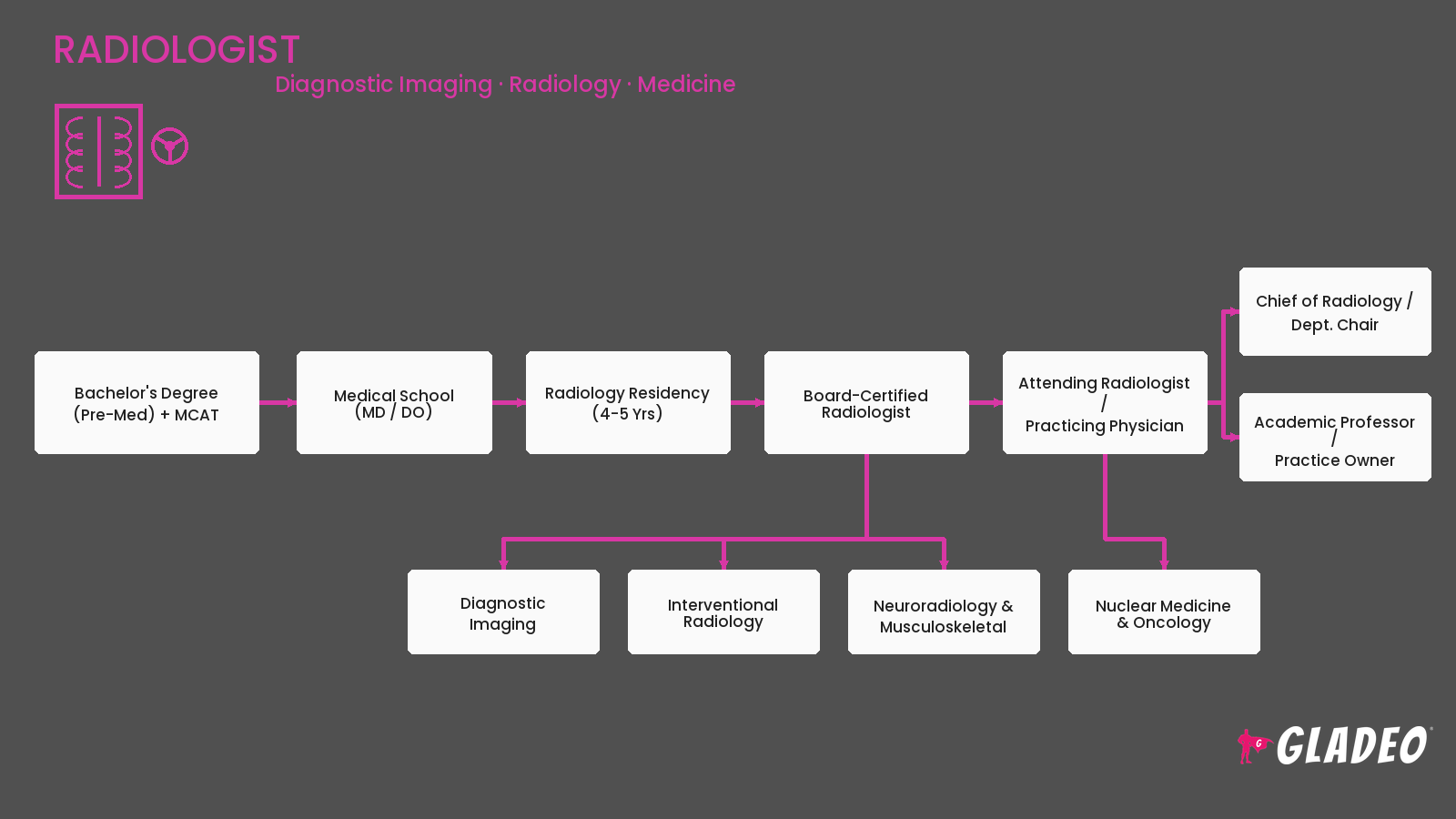
- Excel in medical school, especially in clinical rotations, and take radiology electives to gain experience and recommendation letters
- Apply to residency through the national matching system, ideally with strong grades, test scores, research, and letters from physicians who know your work
- Apply to a one-year preliminary or transitional internship that meets the requirements for radiology training
- Complete a four-year diagnostic radiology residency, or an integrated interventional radiology residency if you want a procedural path
- Consider a fellowship in a subspecialty such as neuroradiology, pediatric radiology, breast imaging, or interventional radiology
- Pass your board certification exams from the American Board of Radiology
- Obtain a state medical license in each state where you plan to practice
- Search for jobs through professional society job boards, physician recruiters, hospital career pages, and your training program's network
- Network with attending physicians, program directors, and alumni, who often know about open positions before they are advertised
- Decide what kind of practice fits you, such as academic medicine, private group, hospital employment, or teleradiology
- Prepare for interviews by learning about the practice's case volume, technology, call schedule, and culture
- Ask thoughtful questions about workload, mentorship, partnership tracks, and opportunities for teaching or research
- Build a strong reputation for accurate, clear, and timely reports that other physicians trust
- Develop a subspecialty in an area where there is strong demand or that you are passionate about
- Take on teaching roles with residents and medical students, which can lead to academic promotions
- Participate in research and quality improvement, and present at conferences like the Radiological Society of North America annual meeting
- Learn to lead by joining committees, serving as a section chief or medical director, or moving into department leadership
- Become an expert in artificial intelligence and imaging informatics, an area where radiologists can have major influence
- Pursue partnership in a private practice, or advance through academic ranks from assistant professor to full professor
- Stay engaged in professional societies, mentor trainees, and keep learning to stay at the cutting edge of the field
Websites:
- Radiological Society of North America (RSNA) - rsna.org
- American College of Radiology (ACR) - acr.org
- RadiologyInfo.org, patient education from RSNA and ACR - radiologyinfo.org
- Society of Interventional Radiology (SIR) - sirweb.org
- American Roentgen Ray Society (ARRS) - arrs.org
- American Board of Radiology - theabr.org
- Association of American Medical Colleges (AAMC) - aamc.org
- American Association of Colleges of Osteopathic Medicine (AACOM) - aacom.org
- Association of Academic Radiology (AAR) - aarad.org
- Society of Nuclear Medicine and Molecular Imaging (SNMMI) - snmmi.org
- Radiopaedia - radiopaedia.org
- AuntMinnie - auntminnie.com
- HOSA - Future Health Professionals - hosa.org
- Student Doctor Network - studentdoctor.net
Books:
- Learning Radiology: Recognizing the Basics by William Herring
- Fundamentals of Diagnostic Radiology by William E. Brant and Clyde A. Helms
- Gray's Anatomy for Students by Richard L. Drake, A. Wayne Vogl, and Adam W. M. Mitchell
- How Doctors Think by Jerome Groopman
- Deep Medicine by Eric Topol
If you find that being a Radiologist isn't the right fit, your interest in medicine, imaging, and problem solving can lead to many other rewarding careers.
- Radiologic Technologist
- Diagnostic Medical Sonographer
- MRI Technologist
- Nuclear Medicine Technologist
- Radiation Therapist
- Pathologist
- Radiation Oncologist
- Biomedical Engineer
- Medical Physicist
- Physician Assistant
Newsfeed

Featured Jobs
Online Courses and Tools